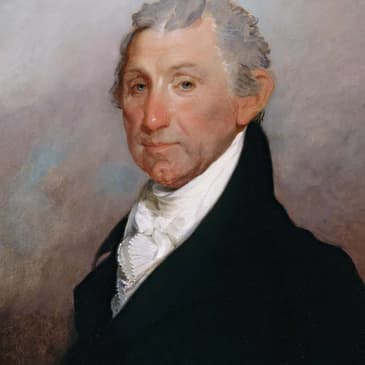
Thanks for joining us for the fourth and final part of the James Monroe story. When we left off in part three, Monroe had help double the size of the nation through negotiating the Louisiana Purchase and risen to become President Madison’s Secretary of State in a time of war. Now, with British soldiers poised to destroy the capital city of Washington, the country will once again call on Monroe where the survival of the republic and Monroe’s own legacy will hang in the balance.
So, sit back and enjoy the conclusion of American President and Founding Father, James Monroe.
[00:00:06] Hello everyone. Welcome to the Almost Immortal History Podcast. I'm your host, Ryan Powers. Thanks for joining us for the fourth and final part of the James Monroe story. When we left off in part three, Monroe had helped double the size of the nation through negotiating the Louisiana Purchase and risen to become President Madison's Secretary of State in a time of war.
[00:00:27] Now, with the British soldiers poised to destroy the capital city of Washington, the country will once again call on Monroe, where the survival of the Republic and Monroe's own legacy will happen. So sit back and enjoy the conclusion of American President and Founding Father, James Monroe.
[00:01:02] As they entered the city, one eyewitness said the 200 British soldiers looked like flames of fire, all red coats. British Major General Robert Ross and Rear Admiral George Coburn led the march. While they intended to spare civilian homes as they lay waste to the city, they made exceptions for several homes where Americans had set up, took aim, and fired on the British. Seeing the first few homes set ablaze, Monroe realized there was nothing more he could do.
[00:01:31] He rode towards Georgetown, away from the British, and then into Virginia. The British came first to the Capitol building, home to Congress, as well as John Marshall's Supreme Court. They shot at the windows to ensure they would not be shot back at before breaking down the door. After ransacking and looting its remaining belongings, they set fire to the building. Ross watched with regret as the 740 books bought during Jefferson's administration that made up the nascent Library of Congress was also burned.
[00:02:01] After the Capitol, they marched to the President's house, burning everything of consequence in their wake. As they entered the home that Dolly, President Madison, and James Monroe had so recently vacated, they took pleasure in sitting at the dining table and helping themselves to the food and wine that had just been set out. Raising his glass, Admiral Coburn toasted derisively to James Madison's, or as he said, Jemmy's, health.
[00:02:26] Once they finished, the soldiers stepped outside, lit, and then threw oil-soaked rags through the windows, setting the President's house on fire and burning it to the ground. As Monroe entered Virginia, he could see the flames from the city. Exhausted and needing safe harbor, he stopped at nearby Rokeby Mansion in modern-day McLean, Virginia. While he knew the owners Richard and Matilda Love, the stopover was unannounced.
[00:02:50] As he was welcomed into the home, he was pleased but surprised to see another fleeing guest of honor was already there, Dolly Madison. Monroe shared the stories of the day and assured Dolly that the President was safe before he finally laid down for a much-needed rest. The next day, the President and First Lady were reunited at Millie's Tavern in Great Falls, Virginia.
[00:03:13] Upon hearing that the British had left Washington by Saturday, August 27th, Monroe sent word to Madison that he should repair to the city as soon as possible. Monroe rode out to meet with the President and then to ride with him, Rush, and Mason back to Washington. Arriving at dark and with the city in ruins, they spent the evening at Richard Rush's house. The next morning, they set out to review the damage and plan their next steps.
[00:03:39] Never was there a time, Monroe told the President and his colleagues, when greater promptitude, decision, and energy were necessary. As they set out onto the streets of Washington the next morning, neither President Madison nor Monroe, nor anyone for that matter, knew where Secretary of War Armstrong was. They had not seen or heard from him. Concerned by the lack of authority, the President asked Monroe to assume temporary command of the War Department until Armstrong re-emerged. Monroe accepted.
[00:04:09] As they rode past the ashes of the President's house, they were approached by the Mayor and a group of concerned residents. They told the President they intended to approach the British with terms of surrender to prevent further burning, looting, or loss of life. President Madison would hear none of it. Monroe, too, had heard enough. I have been charged by the President with the authority to take measure for the defense of the city, Monroe said calmly but defiantly.
[00:04:35] Any attempt to approach the British regarding surrender, he warned, will be repelled by the bayonet. The people must arm. This was not the moment to surrender. It was time to fight back. The crowd was initially taken aback at Monroe's words, but they quickly mobilized into action. Monroe called upon all able citizens to help fortify the city.
[00:04:59] Working day and night, he oversaw the preparations, building defenses and redeploying cannons and 7,000 militiamen to strategic positions throughout the city. Days later, Secretary Armstrong emerged, but the militia refused to fight for him. With no authority left to command, Armstrong had little choice but to resign. President Madison immediately appointed Monroe acting Secretary of War, making him the only Cabinet member to ever lead both the departments of state and war at the same time.
[00:05:30] After safeguarding Washington, Monroe turned his attention to Baltimore, where Generals Ross and Coburn were heading. He also ordered General Andrew Jackson and the 1,000 troops under his command to the defense of New Orleans after receiving word from his negotiators in Ghent that the British were planning to send 12,000 to 15,000 troops there to seize the city and thereby control the Mississippi River.
[00:05:53] He then wrote to the governors of Tennessee, Georgia, and Kentucky requesting that they send 2,500 troops each to bolster Jackson's force. As the Secretary of State, Monroe understood that the British commissioners in Ghent were negotiating from a position of strength and hoped to secure new territory in North America, an outcome that would be intolerable to President Madison, Monroe, and the nation. Monroe also responded directly to the British government in a letter dated September 6th.
[00:06:47] In other words, if you thought the burning of Washington would cause America to surrender, you are sorely mistaken. On September 13th, American forces, now better prepared, were ready in Baltimore. They successfully repelled the British land force against Fort McHenry, a force that would have been led by General Ross, but he was killed in a battle the day before just outside Baltimore. Fort McHenry also withstood an evening barrage of gunfire from the British ships in the Baltimore Harbor.
[00:07:17] Aboard one of these ships was Attorney Francis Scott Key, who had been sent to negotiate the release of prisoners. While on board, Key witnessed the shelling of Fort McHenry, to which he was pleasantly surprised the next morning to see the American flag was still there, yet waving. His famous poem, describing the events, titled The Defense of Fort McHenry, would become America's national anthem, the Star-Spangled Banner.
[00:07:43] The suddenly shifting tide of war also had an impact on the treaty negotiations in Ghent, where a weary British government began to believe that a peaceful state of trade with America made far more sense than a protracted state of war. On January 8, 1815, General Jackson won a decisive victory against the British at New Orleans. President Madison believed this event could end the war.
[00:08:07] When he received news from Ghent just days later that a peace had already been agreed to on December 24th, he and Monroe were overjoyed. Madison had all he needed and said to Congress,
[00:08:41] With the war now over, James Monroe could finally rest. His dedication and focus performing two of the most critical roles to help end the war proved wildly successful, and he emerged a hero of an American war against the British for the second time in his life. Despite his popularity, his friends and family were very worried about his health. The war had taken its toll.
[00:09:07] He had lost so much weight and color in his face, some wondered if he had contracted a disease. Elizabeth and Eliza were also suffering from ill health. So on March 15th, Monroe relinquished the War Department and left Washington to reunite with his family, first in Loudoun County and then to Highland for the summer. The rest did them all good. Of the three, Elizabeth's condition appeared to be the most serious and chronic. With his families and his own health restored,
[00:09:36] Monroe returned to Washington that fall with two goals in mind. He was also a part of his family's career, helping his friend President Madison finish his second term, and then seeking to be his successor in 1816. Given Monroe's background as a military officer, congressman, senator, governor, diplomat, secretary of state, and war, there was really no comparison to any other candidate in terms of qualification.
[00:10:02] His experience, combined with his current popularity, made him the frontrunner by a wide margin, though not a foregone conclusion. He did have to contend with a growing sentiment in the country of Virginia fatigue. The past two presidents, and three of the first four, had all hailed from that state. This was a particularly sore subject for northern states, but also becoming an issue for the expanding states in the West. By 1816, America had added six new states to its original 13,
[00:10:31] as well as the territories of Missouri, Mississippi, Illinois, and Michigan, having tens of thousands of settlers, and themselves, on their way to statehood. There were efforts in 1816 to align behind New York Governor Daniel Tompkins and Georgia's William Crawford, also serving in Madison's cabinet as Secretary of the Treasury. Tompkins was a strong candidate, but support for him, even in New York, was thin. Believing that he was inexperienced in national politics,
[00:10:59] a weakness even more glaring when compared to Monroe, one New York congressman said, It may do to take green hands for members of Congress, but it would be madness to take such for the executive. Crawford was perhaps the strongest alternative, but sensing that Monroe would win, he bowed out of the race in hopes of running for president in the future. New York, also realizing Monroe was likely to win, nominated Tompkins anyway, but with the hope that he might receive the second most votes, and therefore the vice presidency.
[00:11:30] Tompkins, Crawford, and Monroe were all from the Republican Party. Despite figures like George Washington, John Adams, John Quincy Adams, and John Marshall, the Federalist Party had been in decline throughout the 19th century. It still nominated a candidate, Rufus King, also from New York, though King was well aware he had no chance. So certain is the result, King said to a friend. In no preceding election has there been such a calm respecting it. They were all correct.
[00:12:00] In the 1816 election, Monroe got 183 electoral votes to King's 34. James Monroe would become the fifth president of the United States of America. Inauguration Day was set for March 5, 1817. With construction of a new Capitol building still in progress, the ceremony was held at Congress's temporary site, a red-brick building nearby on Pennsylvania Avenue,
[00:12:28] the future site of the Supreme Court building. Appropriately enough, President-elect Monroe was pleased to write to John Marshall, in his 17th year as Chief Justice on the Supreme Court, Sir, I propose to take the oath which the Constitution prescribes to the President of the United States before he enters on the execution of his office on Tuesday next at 12 o'clock, and have to request that you will have the goodness to meet me there for the purpose of administering it.
[00:12:54] I have the honor to be, with the greatest respect, sir, your most obedient servant. Marshall replied immediately, Sir, I have just received your letter of this morning, and shall certainly do myself the honor to attend in the House of Representatives on Tuesday next for the purpose of administering the oath prescribed by the Constitution to the President of the United States. With the greatest respect, I am, sir, your obedient servant. The weather on Inauguration Day was ideal, and the spectators excited.
[00:13:22] With outgoing President Madison in attendance, the crowd watched first as Vice President-elect Tompkins took his oath of office, and then as James Monroe strode to the podium in a sharp black suit. In his remarks, as only one who had not only witnessed, but taken the most active of roles in every moment of his country's life, posed a series of questions and an answer. What raised us to the present happy state? He said to the crowd. How did we accomplish the revolution?
[00:13:52] How remedy the defects of the first instrument of our union, by infusing into the national government sufficient power for national purposes, without impairing the just rights of the states or affecting those of individuals? How sustain and pass with glory through the late war? In answering the questions he posed, Monroe said, The government has been in the hands of the people. To the people, therefore, and to the faithful and able depositaries of their trust is the credit due.
[00:14:22] Had the people of the United States been educated in different principles, had they been less intelligent, less independent, or less virtuous, can it be believed that we should have maintained the same steady and consistent career or been blessed with the same success? At the conclusion of his remarks, and a warm thanks and send-off for outgoing President Madison, he turned to see Chief Justice Marshall. What a proud moment between the two childhood classmates.
[00:14:49] After all that they had seen and done in the service of their country, they stood together, each at the pinnacle of their professions, ready to continue their service to the nation, and despite hailing from different political parties, equally proud and happy for one another. During his address, Monroe laid out his vision for the country over the next four years. First, to promote national unity over political parties, emphasizing that Americans shared so many common interests and a national identity,
[00:15:18] moving beyond partisan and regional hostilities would only strengthen it further. Second, while in peacetime, strengthen the national defense to prevent future conflict. This included a well-trained army, an even stronger navy, and fortifications across the American coastline. He also spoke about investing in state and national infrastructure, paying down the debt, being mindful of expenses, as well as avoiding entanglements in foreign wars. In short, Monroe's message was simple.
[00:15:48] Yet powerful. Unify the nation, secure it, and let it grow. To help him govern, Monroe turned to an array of cabinet members that he knew were both the most qualified, as well as representative of the various regions of the country. For the most prominent post of Secretary of State, he nominated John Quincy Adams, currently serving as Minister to Great Britain, as his father had before him. Few men in the country could match Adams' diplomatic experience, earned over decades of service in Europe,
[00:16:18] or his record of success in advancing American interests abroad. Yet the choice carried political weight as well. Adams was not of Monroe's party, and elevating him signaled a willingness to place national interest above partisan loyalty, as Monroe had promised to do. In doing so, Monroe not only secured one of the most capable statesmen of his generation, but also demonstrated a leadership style rooted in confidence, pragmatism, and unity. Other key appointments were William Crawford at Treasury,
[00:16:48] William Word as Attorney General, and Benjamin Crowninshield as Secretary of the Navy. In time, Monroe's cabinet would become known as one of the strongest in the nation's history, not built around a single towering figure, but a collection of highly capable leaders, lawyers, diplomats, and administrators, each strengthening their respective departments and the country. One leader outside the cabinet was General Andrew Jackson. Since becoming a national hero during the War of 1812,
[00:17:16] Monroe briefly considered him for Secretary of War, but ultimately decided to keep the general in the field. One of Monroe's first official acts was his idea, and one he was most excited about, a presidential road trip. Not since George Washington had a president traveled across the states to meet with the people and see for himself the state of the country. Monroe, already modeling himself in many ways after his boyhood hero, wanted to reinstate Washington's successful trip.
[00:17:46] Monroe's purpose was to help accomplish one of his objectives in his inaugural address, strengthening the national defense by visiting forts, dockyards, and military personnel to see and hear for himself what would be most helpful. Monroe departed Washington in late spring 1817. Traveling by carriage, horseback, and boat, he moved first through the Mid-Atlantic and into the Northeast. In Baltimore, Philadelphia, and New York, he was greeted not with formality alone, but with genuine enthusiasm.
[00:18:17] Crowds gathered along the roads and in public squares, eager to see the president. Wherever he traveled, Monroe presented himself in a manner that seemed to bridge generations, appearing not in contemporary fashion, but in the dignified attire of the revolutionary era. A dark coat, knee-britches, and a tri-cornered hat, an intentional reminder to those who saw him that he was not simply their president, but one of the last living figures of the nation's founding.
[00:18:44] Throughout the journey, Monroe adhered closely to his original purpose. He inspected coastal fortifications, naval yards, and armories, engaging directly with officers and engineers about the state of the nation's defenses. At places like West Point and Boston Navy Yard, he asked detailed questions, drawing on his own military experience to assess both strengths and vulnerabilities. Yet the trip proved to be more than just about national defense. It was in meeting the people from all walks of life that stood out most.
[00:19:15] Veterans of the Revolution came forward to greet him, some recalling shared service, others simply recognizing in him as one of their own. Citizens lined the roads for miles, hosting dinners, parades, and public ceremonies in his honor. Monroe, in turn, made himself accessible, listening more than speaking and taking careful notes of regional concerns. The tour had allowed him to see our union in all its parts, he said,
[00:19:42] and to witness the attachment of the people to their government. In Trenton, New Jersey, Monroe returned to the site of the victorious battle 40 years earlier, where he had spilled his own blood and helped secure a critical victory in America's fight for independence. Emotions ran high, and the warmth of the reception reflected a shared appreciation and awareness for the moment, both for the country and for Monroe himself.
[00:20:07] Well acquainted with the patriotism of the citizens of Trenton, Monroe said to the crowd of well-wishers, the place where the hopes of the country were revived in the war of the Revolution, but a signal victory. As he spoke these words, Monroe carried more than a memory. He also carried the musket ball still lodged in his chest, which remained a lifelong physical reminder of the sacrifice of so many to the nation's cause.
[00:20:33] The reception in Boston to help commemorate the 4th of July was particularly striking. The city, long a center of Federalist opposition, welcomed the Virginia Republican with an unexpected warmth. One observer noted that party divisions seemed to be forgotten, while another wrote that Monroe's visit had produced a general harmony and good feeling such as has rarely been witnessed. Newspapers echoed the sentiment, remarking that the president has everywhere been received
[00:21:01] with the strongest expressions of respect and attachment. Before leaving Boston, he traveled to Peacefield in Braintree, Massachusetts, to dine at the home of former President John Adams and First Lady Abigail Adams. Adams, the last Federalist president, who decades earlier had referred to Monroe as that disgraced minister, had a completely different view of the president now before him. Largely the result of Monroe's own accomplishments and character, but also due to his partnership with his son, John Quincy.
[00:21:32] The agreeable affability and unassuming manners of the president, remarked Abigail, with his polite attentions to all orders and ranks, has made a deep and lasting impression here. By the time Monroe returned to Washington that summer, he had traveled through 10 states, as well as the territories of Maine, Michigan, and Ohio, visiting more than 100 towns and cities and logging 3,000 miles, a remarkable undertaking in an era where such travel was slow, uncomfortable, and often uncertain.
[00:22:01] The journey reinforced Monroe's belief that the nation, though still young and regionally diverse, possessed a deeper unity than many realized. While appreciating the challenge, Monroe saw an opportunity to cultivate a sense of shared national purpose. That sentiment was captured perfectly by a Boston newspaper, The Columbian Sentinel, with an article about Monroe's visit titled, The Era of Good Feelings. The phrase would stick and come to define Monroe's first term as president.
[00:22:34] On October 6th, Monroe joined ex-presidents and his great friends, James Madison and Thomas Jefferson, back home in Albemarle County, as Jefferson helped lay the cornerstone for what would become the University of Virginia. Of his many contributions, Jefferson would list the founding of the university at the very top, along with the creation of the Declaration of Independence. Once John Quincy Adams returned from his post in England, he traded roles with outgoing interim secretary of state, Richard Rush, and would begin a partnership
[00:23:04] with James Monroe that would become one of the most significant in American politics. Adams has a pointed pen, said a complimentary Thomas Jefferson, of the man he had known since he was a boy. Monroe, he continued, has judgment enough for both and firmness to have his judgment control. John Quincy Adams, as both a northerner and former Federalist, did much to underscore President Monroe's want for national unity. Adams' intelligence was matched by very few, if any, American public servants,
[00:23:33] though his personality was often rigid and austere, governed by a stern sense of principle that left little room for ease or charm. Though to Adams' credit, he was not without self-awareness or self-deprecation when it came to his shortcomings. Writing in his diary, he shared that he was aware of the actual defect in my character, but added, I have not the pliability to reform it. Over the next year, the Monroe administration had several quiet but lasting accomplishments.
[00:24:03] First, the United States resolved the long-standing disputes with Great Britain through the Rush-Baggett Agreement, which demilitarized the Great Lakes region and reduced the likelihood of future conflict along the northern border. This spirit of stability continued with the Convention of 1818, which fixed the boundary between the United States and British Canada at the 49th Parallel and established a joint occupation of the Oregon Territory, an arrangement that postponed conflict while preserving American claims to the region. During their first year
[00:24:33] in office, James and First Lady Elizabeth Monroe took particular pride on January 1st, 1818 to reopen the doors of the President's House to the public. While under construction since 1814, Presidents Madison and then Monroe had lived and worked in the nearby Octagon House. In reopening on New Year's Day, the symbolism to the country was clear. America had again been tested, but again had endured. Next,
[00:25:02] the Monroe administration turned its attention to Spanish Florida. Instability, cross-border raids, and Seminole resistance prompted Monroe to again dispatch General Andrew Jackson, this time during the First Seminole War. Jackson's actions proved highly controversial when he invaded Spanish territory without explicit authorization, seized Spanish forts, and executed two British subjects accused of aiding Native resistance. Moves that alarmed Congress and risked war with both Spain
[00:25:32] and Great Britain. Nevertheless, Jackson's campaign shattered Spain's already weak control of Florida and strengthened American leverage at the negotiating table. In 1819, Secretary of State Adams secured the Adams-O'Neill Treaty, through which Spain formally ceded Florida to the United States. By the close of 1819, Monroe had overseen a period of uncommon diplomatic success, securing the nation's borders, reducing the threat of foreign conflict,
[00:26:01] and extending American influence, though it was not without underlying sectional tensions, most notably over the expansion of slavery and economic strain, all of which would come to a head the following year. The year 1820 would severely test the unity that Monroe had worked so carefully to cultivate. The question of Missouri's admission to the Union as a slave state ignited a fierce national debate, exposing deep and widening divisions
[00:26:31] between North, South, and West. What began in Congress as a procedural question of statehood quickly escalated into a fundamental argument over the expansion of slavery and the future of the Union. Publicly, Monroe watched the debates in Congress escalate. Privately, he worked behind the scenes, consulting with congressional leaders, urging moderation, and pressing all sides towards compromise rather than victory. After months of contentious deliberation, Congress reached
[00:27:00] a fragile settlement in the Missouri Compromise, admitting Missouri as a slave state and Maine as a free state, while establishing a geographic boundary for the future expansion of slavery. The resulting compromise was an imperfect settlement and Monroe knew it. He also knew better than most that the controversy had revealed how deeply the issue had and would continue to impact the nation, yet he ultimately concluded that the rejection of the compromise would risk something far worse than its acceptance, preservation
[00:27:30] of the Union. After all, at the same moment, the nation was still reeling from the panic of 1819, the first major economic collapse in American history. The panic and the Missouri question only deepened public anxiety. And yet, this anxiety did not extend to Monroe himself. Friends and colleagues noted his calm disposition amid the chaos, once again, helping the nation and its leaders through a turbulent moment. The movements of a great nation,
[00:28:00] said Monroe later that year, are connected in all their parts, and hasty remedies often produced lasting harm. Despite the turmoil of the Missouri Compromise, the year 1820 marked a special one for the Monroe family, as the Monroe's youngest daughter, Mariah, would become the first child of a president to be married at the president's house on March 9, 1820, to Samuel Gouverneur. Also in 1820, in a striking contrast to the political climate,
[00:28:29] Monroe faced almost no organized opposition in his bid for a second term. In the election of 1820, he was returned to the presidency by an electoral vote of 231 to 1, the single dissenting elector wanting to preserve George Washington's distinction as the only unanimously elected president. Regardless, to achieve such a result during a time of national strain showed the deep respect for James Monroe and the belief that he was the best leader
[00:28:59] to guide the republic, no matter the difficulty. Monroe's second inaugural address did not introduce a new agenda so much as refine his existing one, replacing the optimism of his first term with a more measured emphasis on constitutional restraint, national preservation, and the careful management of a union whose underlying tensions had become impossible to ignore. Just as the president's house had reopened its doors, so too in the past year, had the
[00:29:28] Capitol. Its reopening, along with all its rebuilt government buildings, allowed the country to put the destruction of the war behind it and turn the page toward a more confident and unified future. To help propel the institutions forward, Thomas Jefferson, in an extraordinary gesture, offered Congress his personal library, thousands of volumes gathered over his lifetime to replace what was lost. I have been 60 years making my collection, Jefferson wrote, and have spared no
[00:29:58] pains, opportunity, or expense to make it what it is. Adding that, there is in fact no subject to which a member of Congress may not have occasion to refer. Congress accepted the offer, and from that would emerge the modern-day Library of Congress. The Supreme Court of the United States also resumed its place back in the Capitol. Its presence there underscored an essential reality, while the executive and legislative branches worked to rebuild and unify, the judiciary, under the
[00:30:28] leadership of Marshall, continued to define the constitutional boundaries of that unity. Marshall himself had long understood the fragility of the Union, later reflecting that the Constitution was intended to endure for ages to come, and consequently to be adapted to the various crises of human affairs. Throughout Monroe's first term, the Marshall Court issued a series of decisions that would permanently shape the balance of power within the federal system. In cases such as McCullough v. Maryland, the Court affirmed
[00:30:58] the supremacy of the federal government and upheld the constitutionality of the National Bank, declaring that the government of the Union, though limited in its powers, is supreme within its sphere of action. In Dartmouth College v. Woodward, the Court protected private corporate charters from state interference, ruling that a contract is a contract and may not be impaired by state law. And in the case of Gibbons v. Ogden, the Court would expand the federal government's authority over interstate commerce, ensuring that economic activity
[00:31:28] crossing state lines would not be subject to conflicting local regulations, asserting that the power over commerce is complete in itself, may be exercised to its utmost extent. Taken together, these decisions strengthened the national government in ways that might once have troubled a Republican of Monroe's earlier years. Yet as president, he responded not with resistance, but with acceptance, and in many respects, quiet approval. Experience and national responsibility had tempered his ideology.
[00:31:57] Having seen firsthand the dangers of disunion, Monroe recognized in Marshall's rulings a reinforcement of the very stability he sought to preserve. The Constitution, as interpreted by the Court, was not being undermined, but clarified and strengthened, a living framework capable of sustaining the Republic through the very challenges Monroe and the country now faced. James Monroe's approach to Native American affairs during his presidency was shaped through four decades of direct
[00:32:26] experience dating back to his initial trip to the Western Territories in 1784. The totality of his experiences convinced him that Native nations were not abstractions, but living political communities, and this conviction stayed with him. As president, Monroe insisted that Native Americans be dealt with through formal councils and treaties, not conquest. He insisted that Native delegations be received at the White House, quote, as any foreign dignitary would be.
[00:32:55] And Monroe spoke of the tribes as people whose survival, not destruction, was the government's moral responsibility. Writing privately to Andrew Jackson in 1817, Monroe warned that, nothing is more certain than, if the Indian tribes do not abandon that state and become civilized, that they will decline and become extinct. A sentence that reflected genuine anxiety about the Native survival, even as it revealed the limits of his cultural assumptions. Monroe's most explicit
[00:33:24] statements on Native American policy reveal a president striving, however imperfectly, to frame expansion as a protection rather than domination. In messages to Congress, he acknowledged the pressures of settlement, but argued that removal, if it occurred, must be accomplished peaceably and on reasonable conditions, and only in a manner that would promote the interest and happiness of those tribes. He supported the Indian Civilization Fund Act of 1819, which financed schools
[00:33:53] and agricultural training. Monroe believed education might preserve Native communities rather than erase them. Crucially, during his presidency, he resisted military coercion, rejected mass forced removals, and emphasized consent over compulsion. That same perspective, seeking protection through separation rather than domination, also shaped part of Monroe's thinking on the future of slavery and the free black population of the United States. Like his approach to Native American policy,
[00:34:23] Monroe viewed the coexistence of unequal societies within a rapidly expanding republic as a source of inevitable conflict and human suffering. He came to believe, however controversially, that colonization offered a means of escape from that collision, a way to restrain oppression, offer opportunity, and avert violence without resorting to force. That belief saw Monroe support the efforts of the American Colonization Society and the establishment of a settlement on the West African coast.
[00:34:52] In 1822, during his presidency, the society founded Monrovia, naming its capital in Monroe's honor, and over the following decades, approximately 15,000 black Americans, free-born and formerly enslaved, emigrated from the United States to Liberia. Monroe's second term saw the continuation of domestic stability, even as tensions simmered beneath the surface. The nation's debts
[00:35:21] from the War of 1812 were steadily reduced, federal revenues remained strong, and the army and navy were maintained at levels sufficient for defense without provoking fears of militarism. Above all, his administration preserved peace at home during a period when economic hardship and sectional rivalry might easily have torn the nation apart. Central to that effort was Monroe's close collaboration with Secretary of State John Quincy Adams. While they never developed a friendship like those
[00:35:51] Monroe shared with Jefferson, Madison, Lafayette, and Marshall, there was a sincere respect for Adams' intelligence, experience, and approach. Adams felt the same about Monroe, writing in his diary that the president is a man of candid mind, of pure intentions, and patriotic spirit. Their eight-year partnership was one of the most effective in American history. While they had already secured Florida, resolved boundary disputes with Great Britain, and expanded American commerce abroad, the
[00:36:20] defining achievement for Monroe and Adams came near the end of the second term. Across the Western Hemisphere, Spain's empire was collapsing. By 1822, nations such as Mexico, Colombia, Chile, Argentina, Peru, and Brazil had thrown off Spanish rule and proclaimed their independence. Monroe and Adams saw in these movements a reflection of America's own revolutionary past and an opportunity to shape the hemisphere's future. The administration formally recognized
[00:36:50] these new republics. Those decisions strengthened American trade and signaled that the Western Hemisphere was no longer a European extension. That signal was aimed squarely across the Atlantic. In Europe, the conservative monarchies of Russia, Austria, and Prussia, known as the Holy Alliance, sought to suppress revolutionary movements, and reports soon suggested that Spain might receive European support to reclaim its former colonies. Monroe and Adams understood the danger.
[00:37:20] Silence might invite intervention, but overreach might provoke it. Drawing on decades of diplomacy and their understanding of European politics, Monroe and Adams determined to state clearly, rationally, and publicly a new framework for the Western Hemisphere. The ground I wish to take, wrote Monroe to Jefferson, is that of earnest remonstrance against the interference of the European powers by force with South America, but to disclaim all interference on our part with Europe, to
[00:37:49] make an American cause and adhere inflexibly to that. Adams agreed. The two worked together to shape the language of the President's annual message. They also collaborated on the best ways to inform the various foreign governments ahead of the message so as not to surprise, be misunderstood, or provoke any foreign power. On December 2, 1823, President Monroe's message was read aloud to the members of Congress. We owe it, therefore, to
[00:38:18] candor and to the amicable relations existing between the United States and those powers, to declare that we should consider any attempt on their part to extend their system to any portion of this hemisphere as dangerous to our peace and safety. With the existing colonies, or dependencies, of any European power, we have not interfered, and shall not interfere. But with the governments who have declared their independence and maintained it, and whose independence we have, on great consideration and on just
[00:38:47] principles acknowledged, we could not view any interposition for the purpose of oppressing them, or controlling in any other manner their destiny, by any European power, in any other light than as the manifestation of an unfriendly disposition towards the United States. With those words, Monroe and Adams effectively set forth a new era in America, free from foreign interference. Thomas Jefferson, upon reading the proposed message, said, The question presented by these
[00:39:16] letters you have sent me is the most momentous which has ever been offered to my contemplation since that of independence. That made us a nation. This sets our compass and points the course which we are to steer through the ocean of time opening on us. As Monroe entered his final year in office, he continued to enjoy widespread popularity, but an election year always tested the passions of the country.
[00:39:45] The election of 1824 would be no exception, and in fact, proved to be far worse than most. What Monroe had hoped would be the natural orderly continuation of Republican government, instead revealed the fragility beneath the so-called era of good feeling. The calm he had worked to preserve at home and abroad seemed to give way to ambition and rivalry. While the presidencies of Jefferson, Madison, and Monroe had done much to relegate the Federalist Party to
[00:40:14] extinction, and to achieve what Monroe had long advocated, a largely nonpartisan political culture, politics remained politics. With no credible second party to check competition, the Republican Party fractured into rival factions, each claiming to represent the true legacy of the revolution. The absence of party competition did not eliminate conflict, it simply turned it inward. The leading contenders for the presidency in 1824 were John Quincy
[00:40:44] Adams, Andrew Jackson, Henry Clay, and William Crawford. Monroe refused to endorse a successor. He believed that a president should stand above electoral intrigue and that overt favoritism would corrode both the office and the constitutional process. When the ballots were cast, no candidate commanded a majority, either in the popular vote or the electoral college. Andrew Jackson led both, but fell short of the constitutional requirement. Adams, Clay, and Crawford divided the
[00:41:13] remaining support almost evenly. As a result, the presidency would be decided by the House of Representatives. By the time of the February 1825 vote, the contest was effectively down to two. Clay's fourth-place finish in the vote totals eliminated him from consideration, and William Crawford had suffered a stroke rendering his candidacy moot. The House chose John Quincy Adams as president, elevating him over Jackson through a
[00:41:42] coalition of state delegations led by Henry Clay. When Adams then appointed Clay as secretary of state, Jackson's supporters denounced the result as a corrupt bargain. Monroe never joined in that accusation. He accepted the outcome as constitutional and proper, even if painful, and refused to inflame a divided public with judgment or commentary. The election of 1824 marked the end of the era of good feelings, not because Monroe had failed, but
[00:42:11] because the nation itself had changed. Through the tensions of the election year also came a pleasant surprise, the return to America of the Marquis de Lafayette. At President Monroe's invitation, Lafayette arrived in the summer of 1824 as the nation's guest, embarking on what would become a sweeping farewell tour and lasting more than a year. Nearly half a century after Yorktown, now in his late sixties, he was the last surviving major general of the
[00:42:40] Revolutionary War. He was greeted everywhere by crowds and parades rarely equaled in American history. For Monroe, Lafayette's visit was deeply personal. Their reunion at the president's house was emotional and heartwarming to all who witnessed it. John Quincy Adams was sworn in on March 4, 1825, with James Monroe present to witness the peaceful transfer of power.
[00:43:08] As Adams spoke, Monroe could reflect on the successful eight years set amidst a half-century of service to his country. He had presided over a nation that was more secure, more expansive, and more confident than when he entered office. His administration defined the future of American foreign policy, strengthened the authority of the federal government and helped guide the country through economic recovery. In a nod to his predecessor and the presidents before him, Adams
[00:43:36] directed this passage to Monroe. Administered by some of the most eminent men who contributed to its formation through a most eventful period in the annals of the world, and through all the vicissitudes of peace and war incidental to the condition of associated man, it has not disappointed the hopes and aspirations of those illustrious benefactors of their age and nation. It has promoted the lasting welfare of that country so dear to
[00:44:03] us all, it has to an extent far beyond the ordinary lot of humanity secured the freedom and happiness of this people. Former President Monroe and Elizabeth left Washington for their home at Oak Hill, which they believed would be better for Elizabeth's health than Highland. She had suffered from ill health for more than a decade, but her condition had gotten worse. After taking control of the existing land
[00:44:30] at Oak Hill years earlier, Monroe sought the advice of both Jefferson and James Hoban, the designer of the president's house. What emerged was a beautiful two-story brick mansion that played host of family and friends for the Monroes, including President Adams and Lafayette just months into Monroe's retirement. James went back to farming as an occupation with some success. Neither age nor life in politics had altered his calm and kind demeanor.
[00:44:57] Seeing Monroe interact with others while working the fields or around the house, an employee remarked that Monroe was one of the most polite men I ever met. Monroe corresponded often with Jefferson and Madison. Jefferson's health had declined significantly by 1825. Monroe accompanied Lafayette to Monticello in the fall, where the general was to be honored at the University of Virginia. Monroe was a member of the University's Board of Visitors and now active in its governance.
[00:45:24] He had even contributed some of the land on which the university was built. Lafayette would return to France in 1826. The reunion between him and Monroe was special for both men. He had not only spent time with Monroe, but with his family, even accompanying Mariah and Monroe's deaf grandson to see a doctor in Baltimore. As the two friends said their goodbyes, they likely knew this would be the last time they would see each other in person.
[00:45:53] As the nation prepared to celebrate its 50th birthday, it was clear Jefferson did not have long to live. He struggled throughout June and early July, and died at Monticello on Independence Day, July 4, 1826. Unbeknownst to him, his friend, former President John Adams, had died just hours before at his home in Boston. The two men most responsible for the Declaration, Jefferson, referred to as the Penn, and Adams,
[00:46:22] the Voice, died on the same day, and that that day should be the 50th anniversary of the most important day of their lives, and perhaps in the life of the nation, was simply too remarkable to explain. The deaths of these founders saddened all Americans, but none more so than James Monroe and James Madison, who had lost their great friend and mentor, and President John Quincy Adams, who had lost his father and hero.
[00:46:54] Monroe, on his last trip to Washington, tried to make amends with Alexander Hamilton's widow, Eliza. He explained to her, as he had tried to do with her husband, that he was not responsible for the damage that had come to Hamilton's reputation, but Eliza wouldn't hear of it. So Monroe bowed politely and left. James and Elizabeth became great-grandparents when Eliza's daughter Hortensia gave birth to a daughter Harriet in 1830.
[00:47:24] Unfortunately, later that same year, both Elizabeth's health and the health of Monroe's son-in-law George Hay declined rapidly. George died on September 21st, which devastated the Monroes. But then, the unthinkable happened. Elizabeth Monroe died just two days later at Oak Hill. James Monroe was despondent from the loss of his wife and partner of 44 years. His friends and family were deeply worried about him.
[00:47:54] It appeared to everyone in the weeks that followed that the light had gone out of the former president. Because of this, they also feared that he wouldn't be far behind his beloved wife. Mariah, realizing that her family needed help, moved both her father and her widowed sister Eliza to live with her family in New York City. Knowing health would not permit him to return to Virginia, Monroe wrote to James Madison in April 1831,
[00:48:49] Monroe also exchanged final letters with Chief Justice Marshall, his friends since they were teenagers. Their reflections were both personal and a nod toward posterity. He continued on in his letter to further downplay his own actions in public life.
[00:49:18] Responding to this, Marshall gently corrected his friend that, few men have been more fortunate in the confidence of their country, and few have shown a more conscientious desire to deserve it. As everyone feared, Monroe's health declined steadily through the first half of 1831. As they approached Independence Day, Monroe knew his time was short. He had friends and family visit to say their goodbyes.
[00:49:45] Monroe also asked a final request, that his longtime dining servant and coachman, Peter Marks, be given his freedom, which he was granted. On July 4, 1831, Monroe could see and hear the celebrations building for Independence Day. Fittingly, his room overlooked the intersection of Prince and Lafayette streets. His final words were not recorded, but to die on the 55th anniversary of the nation's independence,
[00:50:15] within sight and earshot of the celebration for the nation he had fought for, done so much to build, and guide forward, felt heavy with meaning. James Monroe died peacefully that afternoon, the third president to do so on July 4, and the last of the founding father presidents. In a life that saw James Monroe rise from modest beginnings to service as a revolutionary soldier,
[00:50:42] congressman, senator, diplomat, secretary of state and war, and finally the nation's fifth president, his story is extraordinary by any measure. Titles, however, were never his aim. His ambition was to serve, to contribute, and to leave behind a better nation. In each of those pursuits, he excelled beyond measure. Perhaps John Quincy Adams, in his eulogy weeks later, said it best.
[00:51:12] He sought no popularity by arts of conciliation, nor did he court applause by splendid displays. His ambition was of a purer and loftier kind, the ambition of deserving well of his country. If the history of his country shall do justice to his memory, it will record that he administered its government with moderation, firmness, and a constant devotion to the public good.
[00:51:41] James Monroe could not have wished for a more fitting judgment.