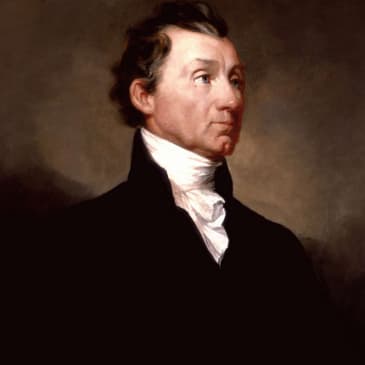
Many of us know the stories of America’s Founding Fathers. The lives and accomplishments of George Washington, Thomas Jefferson and James Madison, the nation’s first, third and fourth Presidents are familiar. Though many might not know the story of the fifth President, also a Virginian and a close friend and trusted ally of his predecessors. But this President would become the last of the Founding Fathers, a hero of the Revolution who bled for his country, a master diplomat who helped double the size of his new nation and a leader who defined America’s place in the world for generations.
So, sit back and enjoy the story and the focus of today’s episode, American President and Founding Father, James Monroe.
[00:00:06] Hello everyone. Welcome to the Almost Immortal History Podcast. I'm your host, Ryan Powers. Many of us know the stories of America's founding fathers. The lives and accomplishments of George Washington, Thomas Jefferson, and James Madison, the nation's first, third, and fourth presidents are familiar. Though many might not know the story of the fifth president, also a Virginian and a close friend and trusted ally of all of his predecessors.
[00:00:31] But this president would become the last of the founding fathers, a hero of the revolution who bled for his country, a master diplomat who helped double the size of his new nation, and a leader who defined America's place in the world for generations to come. So sit back and enjoy the story and the focus of today's episode, American President and Founding Father, James Monroe.
[00:00:54] It was August 24, 1814 in the American capital of Washington. By nightfall, the White House and Capitol building were on fire, set ablaze by British soldiers during the War of 1812.
[00:01:19] The city seemed to recoil in disbelief. Smoke rose into the sky in towering columns, visible for miles, as British troops moved methodically from building to building. Government officials and civilians alike fled into the surrounding countryside. For a terrifying moment, it appeared that the American experiment, barely three decades old, might collapse under the weight of humiliation and fear. James Monroe did not share that belief.
[00:01:47] Days earlier, sensing danger where others hesitated, Monroe rode south of the city to observe the British advance himself. He watched as they moved inland, measured their intent, and grasped what few others did, that Washington, not Baltimore, was the true target. He sent urgent warnings to President James Madison. He pressed for preparations that came too late, and he stood on the field of Bladensburg as American resistance dissolved into chaos. When the line broke, Monroe did not disappear.
[00:02:16] He stayed close, driven less by title than by instinct. When dawn came, Washington lay in ruins. Charred walls stood where Congress had once debated. The President's house was a hollow shell. But Monroe immediately turned loss into action. He helped gather scattered officials. He focused attention on fortifying Washington's defenses and preparing other cities that might be next.
[00:02:40] With calm urgency, he worked to organize militia, coordinate commanders, and restore the machinery of government while the ashes of the capital city were still warm. In those hours, Monroe was not simply Secretary of State and Secretary of War. He was the binding force holding the nation together. The burning of Washington would forever mark the War of 1812, but it also revealed the measure of James Monroe.
[00:03:06] He did not win the battle, but he prevented catastrophe from becoming collapse. Out of chaos, he brought resolve. In one of the darkest moments of the young public, Monroe proved himself not merely a survivor of the revolution, but one of its last and most dependable defenders. This moment, as remarkable as it was, was only one event in a much larger and consequential life.
[00:03:30] More than a half a century earlier, his story began at nearly the same instant his countries began its own. In 1758, the English colony of Virginia was at war. Britain and France were locked in a centuries-old rivalry that had spilled into the New World. In what would become known as the French and Indian War, each side allied Native American tribes to strengthen their position on the continent.
[00:03:57] Virginians sent hundreds of their sons into the fight. During that year, on April 28th, James Monroe was born. He was the second of five children born to Spence and Elizabeth Monroe. Of his father, Monroe wrote that he was a very worthy and respectable citizen possessed of good land and other property. Of his mother, he recalled a very amiable and respectable woman possessing the best qualities of a good wife and a good parent.
[00:04:24] The Monroe family farm in Westmoreland County spanned roughly 200 acres, sizable, though not among the largest in the area. They were comfortable, but not wealthy. From an early age, James worked on the farm alongside his father. He fed the animals, milked the cows, tended the crops, and eventually took up the plow himself. He learned to hunt and manage the farm, responsibilities that instilled discipline and independence.
[00:04:49] At 11, he was enrolled in Campbell Academy, a prestigious school nearby run by the dynamic Reverend Archibald Campbell. 25 students only were admitted into the school, said Monroe, but so high was its character that youths were sent to it from the more distant parts of Virginia. One of the students who traveled more than 100 miles to board there was future Supreme Court Justice John Marshall. Though Marshall was three years older than Monroe, the two struck up a strong friendship.
[00:05:18] Through Monroe's first 14 years, life followed a steady course. Then in 1772, his mother died in childbirth. Less than two years later, his father died as well. As the oldest male in the house, James was prepared to leave school to run the family farm. Instead, Elizabeth's brother, Joseph Jones, a wealthy judge and member of Virginia's House of Burgesses, took responsibility for his niece and nephews.
[00:05:44] After completing his studies at Campbell Academy, Judge Jones enrolled James into the College of William & Mary in 1774, where so many of the leading men of Virginia had attended. Of his 60 classmates, Monroe was pleased to find among them his friend, John Marshall. Through his uncle, Monroe met many of the leading men of Virginia, such as Thomas Jefferson, George Mason, Patrick Henry, and George Washington. Henry, a fiery and effective orator. Mason, a thoughtful scholar and political philosopher.
[00:06:14] Jefferson, quiet, but a talented writer and thinker. Washington, a hero of the French and Indian War. Throughout Monroe's childhood, he was exposed to the key events that would lead America to revolution. He was seven in 1765, when Britain declared the Unpopular Stamp Act, taxing all paper goods throughout the colonies. He was 11 at the time of the Boston Massacre, and 15 during the Boston Tea Party. By the time he arrived at William & Mary, events were accelerating.
[00:06:44] April 19, 1775, shots were fired at Lexington and Concord. Massachusetts farmers stood their ground against British troops and forced a retreat to Boston, where King George had steadily increased troop presence from 700 to 4,000 to suppress the growing rebellion. War had begun. In Virginia, tensions escalated quickly.
[00:07:09] British authorities responded to unrest with increased troop deployments and harsh new policies, called the Coercive Acts, to tighten British control. Feeling the threat of British naval power, Virginia's House of Burgesses relocated from Williamsburg to Richmond. There, the colony's leaders convened to determine Virginia's course of action in the face of mounting pressure. The discussions included Representative Patrick Henry of Hanover County delivering his immortal phrase,
[00:07:35] Give me liberty or give me death, to stir his fellow Virginians to join the fight. Britain's governor of Virginia, Lord Dunmore's response to the growing tensions, did as much to propel his fellow Virginians towards joining their sister colony of Massachusetts as the actions of the British Army did in Boston itself. Dunmore ordered troops to seize gunpowder supplies in Williamsburg to prevent their use by colonial militias.
[00:08:00] Catching wind of what would become known as the gunpowder incident, citizens led by Patrick Henry and joined by James Monroe and his college classmates descended upon the governor's mansion to confront Dunmore. Sensing the danger, Dunmore fled the mansion to a British ship anchored in the nearby York River. With the governor gone, Monroe and the militia stormed the mansion in search of arms. Moving from room to room, they discovered hundreds of muskets, swords and supplies, securing them for the Patriot cause.
[00:08:29] In the weeks that followed, Monroe did not return to the ordinary life of a college student. Instead, he stepped more fully into the cause he had just helped arm. He joined the Virginia militia and soon entered the Continental Army as a second lieutenant in the 3rd Virginia Regiment. He was joined again by John Marshall, who had already joined the cause with his father in a nearby militia.
[00:08:51] Like many others inspired by George Washington's example, Monroe agreed to serve without pay, committing himself not out of wealth or comfort, but conviction. Throughout 1775 and 1776, Monroe, Marshall and the rest of the Virginia 3rd trained, marched and prepared to be called to service. Meanwhile, the Second Continental Congress, meeting in Philadelphia, declared independence from Great Britain on July 4th, 1776.
[00:09:18] Nothing like it had ever been attempted on such a scale. Thirteen colonies representing a wide variety of interests had now united to sever ties with their mother country, to be governed as a republic, granting power to its citizens rather than a monarch. But the members of the Continental Congress, as well as the citizens in each state who supported them, like 19-year-old James Monroe, knew that declaring independence was merely the first step.
[00:09:46] If they wanted to remain free, they would have to fight for it. And the fight was not with just any opponent, but with the largest and most fearsome military on the planet. In August 1776, finally called to serve, James Monroe and the 3rd Virginia marched more than 400 miles in the sweltering summer heat to join George Washington's struggling army at Harlem Heights in New York.
[00:10:12] Over the previous year, Washington had been forced to transform a patchwork of militias, farmers, tradesmen, and boys with little training and even fewer supplies into something resembling a fighting force. There had been moments of promise, including the bold seizure of artillery from Fort Ticonderoga and the British evacuation of Boston. But the army remained dangerously undermanned and under-equipped. An exhausted Monroe arrived to find a force held together largely by Washington's resolve.
[00:10:41] Great joy was expressed upon the Virginians' arrival, but there was little time to rest. Within days, word spread that British General Howe was preparing his next move. On September 16th, British troops landed at Kipps Bay with overwhelming strength, sending the Patriot defenders into a chaotic retreat. Monroe and the Virginians were standing guard seven miles away in Harlem. They were too far away to engage, but could see and hear the rout unfolding.
[00:11:09] As the Americans retreated towards Harlem, the British followed. On high alert, Monroe and the 3rd stood ready for the fight. As their fellow soldiers from Kipps Bay returned, the Virginians saw the British redcoats and Hessian soldiers bearing down on them. Most of the Virginians had never seen battle. That was about to change. When the British forces advanced, the Virginians did not retreat. They stood their ground and returned fire.
[00:11:36] While not a decisive victory, the Virginians had acquitted themselves well, and the engagement proved something vital. American soldiers could fight and hold the British in their tracks. General Washington agreed, praising the courage of the Virginians and the New England troops responsible for the outcome. In the weeks that followed, Monroe would take part in another small victory just north of Harlem, near New Rochelle. Still, the broader campaign throughout 1776 remained grim.
[00:12:06] They exceed us in numbers greatly, wrote Lieutenant Monroe. The enemy, knowing how inconsiderable Washington's forces were, pressed on him. Aware of this disadvantage, Washington began a slow but strategic retreat south into New Jersey, always mindful to keep a river or other waterways between his army and the British. Once the Continentals were safely across each body of water, Washington instructed them to burn the bridges and passageways to slow the British pursuit.
[00:12:34] By doing so, he bought his army time. Years later, Monroe would recall this as a retreat which will forever be celebrated in the annals of our country for the patient suffering, the unshaken firmness, and gallantry of this small band. While hindsight showed the wisdom of Washington's choice, the circumstances in the moment felt as if American independence may be short-lived. With the retreat and subsequent British advance south into New Jersey,
[00:13:02] the Continental Congress, concerned that the capture of Philadelphia and themselves was the British next objective, relocated Congress to Annapolis, Maryland. By mid-December, the Americans were across the Delaware River from Trenton, New Jersey, just 30 miles from Philadelphia. Just before Christmas, the American army had dwindled from 19,000 to less than 5,000 due to casualties, illness, enlistments expiring, or troop desertion.
[00:13:30] Nearly half of the 600 new Virginians were listed as unfit for duty. Despite all of this, and in no small part because of it, Washington knew the moment had come. Retreat had kept them alive, but it was time for something more. The army needed to strike a blow against the British, or risk losing the war. Christmas Day at night, one hour before day, is the time fixed upon for our attempt on Trenton, wrote Washington to one of his colonels on December 23.
[00:14:01] For heaven's sake, keep this to yourself, as the discovery of it may prove fatal to us. Washington had chosen Trenton, New Jersey, on Christmas night because he knew the 1,500 German Hessian mercenary soldiers in camp there would not suspect an attack of that size or at that time. The stakes could not have been higher. The potential reward, a badly needed victory, but defeat could spell ruin.
[00:14:29] Due to their depleted numbers, Lieutenant Monroe was one of the only Virginia officers fit to fight. He volunteered eagerly. His assignment was among the most dangerous. He and a small advance party of 40 men would cross the icy Delaware River ahead of the main force to secure key positions and ensure the attack remained a surprise. The crossing itself was brutal. A nor'easter swept through the region, bringing snow, sleet, and fierce winds.
[00:14:57] It was as severe a night as I ever saw, wrote one officer. Monroe, Captain William Washington, a distant cousin of George Washington, and their men were transported across 800 feet of icy water by Massachusetts Colonel John Glover and his marble headers, the same regiment of maritime heroes who had helped Washington and the Continentals evacuate Brooklyn just months earlier. They rode as silently as they could.
[00:15:23] Reaching shore, the soldiers began their several miles and hours-long march through the storm, while the Marblehead Regiment returned to bring back the remaining 2,400 troops, 50 horses, and 18 cannons, as well as officers such as Henry Knox, Nathaniel Green, and George Washington for the battle ahead. Monroe, William Washington, and their men marched silently through the blustery darkness and worsening storm.
[00:15:47] Arriving outside of Trenton hours later, they managed to avoid attention from all but a few passers-by. As they approached the town, several dogs inside their homes, alerted to the soldiers' presence, began to bark. One resident, awakened by the barking, came outside to question what the men were doing. Assuming they were enemy soldiers, he was delighted to hear Lieutenant Monroe's accent and realization that they were Continentals. Monroe urged the man to go back inside, but he refused.
[00:16:16] He first offered warm shelter for the soldiers, but when Monroe politely declined, the man, Dr. John Riker, brought them food outside and insisted he accompany the soldiers in town as he may be of some medical assistance. While the attack was planned for dawn, Washington's army arrived in full just after sunrise. While the weather had helped conceal their movements, it also made the trip slower going.
[00:16:41] With Monroe and the men already in place, they had the perfect view of the north side of town, with General Knox and his regiment of soldiers and cannons just behind them. Captain Washington, Lieutenant Monroe, and the 3rd Virginia led the attack into Trenton. As they had hoped, they caught the Hessians by surprise. As the Americans opened fire, the Hessians reacted quickly, mobilizing troops and positioning artillery. Monroe and Captain Washington saw two cannons heading their way and immediately opened fire to stop their advance.
[00:17:12] General Knox's regiment fired their cannons to support the Virginians. The incoming fire overwhelmed the Hessians who retreated into town, leaving the cannons in the hands of the Americans. Upon hearing of the cannons capture, more Hessians were ordered to immediately recapture them, which they did. Seeing this turn of events, Captain Washington, 200 yards away, ordered the 3rd Virginia to charge and retake the cannons. Washington led the charge of his men, with Monroe by his side.
[00:17:39] The Hessians took aim at the brave officers in front and opened fire. Captain Washington was struck almost immediately before reaching the cannons. Monroe, seeing that the captain's wounds weren't fatal, assumed command, ordering the captain to be pulled to safety to continue the charge. A Hessian soldier, seeing a new officer in front of the charge, took aim and fired. The musket ball struck Lieutenant Monroe through his upper chest and lodged into his shoulder. He collapsed instantly.
[00:18:06] While the shot didn't kill him, it had struck an artery, and he was bleeding badly. Monroe's soldiers pulled him to safety, where Dr. Riker applied a clamp to the artery, saving Monroe's life. The 3rd Virginia, motivated by their fallen officers, retook the Hessian guns. The Battle of Trenton lasted only 45 minutes, with 21 Hessians killed and 900 captured. Miraculously, zero Americans were killed.
[00:18:33] Only four were wounded, including William Washington and James Monroe. The victory at Trenton proved to be every bit the jolt George Washington had hoped it would be. In the days following the battle, newspapers were filled with the accounts of Washington's crossing of the Delaware, the Night March, and overwhelming success.
[00:18:55] From the Continental Congress, John Hancock said that the American victory was all the more extraordinary, given that it had been achieved by men broken by fatigue and ill fortune. For Monroe, while he was lucky to be alive and would need another 10 weeks to recover from his near-fatal wound, he was also filled with pride. Pride in his men who helped secure the victory at Trenton, and surely personal pride for his role in the victory. George Washington agreed, promoting Monroe to captain for his bravery and leadership.
[00:19:25] Despite the honor of promotion, advancement brought new challenges. Unlike more junior officers, captains were expected to recruit their own company of soldiers. Once healed, Monroe returned home to Virginia in the spring of 1777 to do just that, though his efforts proved unsuccessful. Recruiting proved challenging for most in 1777 due to the ending enlistments, economic challenges, and war wariness. Monroe wrote that not more than six men were willing to enlist.
[00:19:55] He confessed that he preferred the fatigue and danger of active service to the work of recruitment. Unable to raise sufficient troops, he accepted a position on the staff of Major General William Alexander, known as Lord Sterling. At General Sterling's side, Monroe saw the war from a whole new vantage point. Young as I was, wrote Monroe, I became acquainted with all the general officers of the Army and their aides. Those relationships broad Monroe's views beyond his provincial upbringing in Virginia.
[00:20:24] He met Washington's aide, Alexander Hamilton, and another fellow officer named Aaron Burr. Monroe also met and quickly befriended a 20-year-old French aristocrat who had sailed across the Atlantic at his own expense to take up arms with the Americans, the Marquis de Lafayette. At the Battle of Brandywine in September 1777, Lafayette proved his valor under fire and confirmed the promise that had first drawn Monroe to him.
[00:20:51] Though inexperienced in large-scale combat, Lafayette ran toward enemy fire while rallying retreating American troops, refusing to leave the field even as the battle turned against the Continental Army. His courage came at a cost. Struck by a musket ball that tore through his leg, Lafayette collapsed amid the chaos. Monroe, witnessing his new friend's heroics, assisted in carrying the wounded Frenchmen to safety, an intervention that likely saved Lafayette's life.
[00:21:18] Once they arrived at the hospital, Monroe stayed with Lafayette to attend to his needs, deepening their friendship even further. By the end of 1777, Monroe was promoted again, this time to Major, an extraordinary rise for a young man not yet 20 years old. Major Monroe followed the army into the bitter winter at Valley Forge outside Philadelphia in 1778. There, he again spent time with John Marshall amid the horrors the soldiers experienced that winter.
[00:21:48] Marshall described the experience. At no point of the war had the situation of the American army been more perilous. He further described the troops' want of food, clothes, and shoes throughout much of the winter. In total, more than 3,000 men would die that winter due to starvation, disease, and exposure. Yet from hardship came transformation.
[00:22:12] As spring approached, the temperatures thawed, and the soldiers emerged with a new resolve, thanks to the efforts of yet another foreign-born ally, Baron von Steuben. The Prussian-born, former aide-de-camp to Prussia's King Frederick II, von Steuben had come to the attention of Benjamin Franklin in Paris. Impressing both Congress and General Washington, he was appointed Inspector General,
[00:22:34] and while at Valley Forge, helped transform the Continental Army from a loose collection of state regiments into a unified, disciplined fighting force. The impact of von Steuben was felt almost immediately. In June 1778, at the Battle of Monmouth, New Jersey, the Americans held their ground with a steadiness they did not possess earlier in the war.
[00:22:56] During the battle, Lord Sterling, trying to anticipate where British General Charles Cornwallis would attack, tasked Major Monroe with the reconnaissance mission. Monroe and 70 men snuck behind enemy lines to observe formations. It became clear to Monroe that the attack would come on General Washington's right flank. Monroe scribbled notes to Sterling and Washington and sent runners to deliver the news immediately.
[00:23:21] Monroe and his men made it back safely, and in time for General Sterling to share that Monroe's news had helped repel the British attack. Despite his success under Sterling, Monroe continued to want a command of his own. He received help from George Washington himself. The General, who did not send recommendations lightly, sent a letter on Monroe's behalf saying, It is with pleasure that I take occasion to express to you the high opinion I have of his worth. He has in every instance maintained the reputation of a brave, active, and sensible officer.
[00:23:51] As we cannot introduce him into the Continental line, it were to be wished that Virginia could do something for him. It would give me particular pleasure as the esteem I have for him and a regard to merit conspire to make me earnestly wish to see him provided for. Washington's ringing endorsement did get Monroe promoted to lieutenant colonel, but the command he sought remained elusive.
[00:24:13] His uncle, Joseph Jones, now a member of the Continental Congress in Philadelphia, urged his nephew to consider contributing to his nation in other ways, namely, as a lawyer and public official. Monroe, still wanting to serve his country, but seeing no prospect to do so in the Army, agreed with his uncle and returned to Virginia to begin a new chapter.
[00:24:37] Providing the formal introduction, Joseph Jones sent Monroe back to Williamsburg in 1779 to meet with Governor Thomas Jefferson. The 36-year-old Jefferson was elected to succeed Patrick Henry as Virginia's governor just months earlier. After penning the Declaration of Independence in 1776, Jefferson returned to Virginia to serve in the state's House of Delegates.
[00:24:59] There, he helped pass sweeping legislation, including bills to ensure religious freedom, the establishment of tax-supported public schools, as well as banning further importation of slaves. It didn't take long for Jefferson and Monroe to form a connection. In Jefferson, 15 years his senior, Monroe saw a brilliant mind and willing mentor. In Monroe, Jefferson saw a disciplined young veteran of the Revolution with promise far beyond his years. Jefferson agreed to take Monroe on as a law student.
[00:25:28] Despite serving as governor at the time, Jefferson, beginning in 1780, taught Monroe and several others using his extensive personal library and the practical study of his own legal cases, blending classical legal theory with first-hand instruction in Republican governance. Jefferson also introduced Monroe to Jefferson's own mentor and brilliant legal scholar, George Wythe, serving as William and Mary's first-ever professor of law.
[00:25:53] With the Revolutionary War still raging, and the British capture of Charleston, South Carolina, Jefferson moved Virginia's capital and seat of government from Williamsburg to Richmond in 1781, and Monroe moved with it. Anticipating a British invasion of Virginia, Governor Jefferson asked his law student James Monroe for help. Promoting Monroe to a full colonel, Jefferson sent himself to coordinate communication lines with the Carolinas.
[00:26:19] You will proceed with the riders provided for you, Jefferson wrote, stationing one every 40 miles, where you will continue yourself observing their movements, and when their importance requires it, communicating them to me. Monroe linked the communications network across the three states, and with riders traveling more than 100 miles per day, word traveled fast to Governor Jefferson. After Monroe's success, Jefferson had intended to give Colonel Monroe a battlefield command.
[00:26:45] But when recruiting new regiments proved as difficult as it ever had, Jefferson suggested that Monroe return to Fredericksburg to continue studying law instead. The timing of sending Monroe north and the inability to recruit proved devastating as the British moved thousands of troops into Virginia, and on January 5, 1781, surprise-attacked Richmond. With insufficient troops to protect itself, George Washington sent General Lafayette and 1,000 troops to Virginia's defense.
[00:27:13] While Jefferson and most of the state government officials were able to escape, the Americans were unable to repel the British forces which captured and then burned Richmond. Monroe and Fredericksburg during the attack rode to Lafayette's camp to offer his services. While genuinely pleased to see his friend, Lafayette lamented that they had no room for more officers, only enlisted soldiers. To see the capital of the most powerful state in the young republic fall was yet another low point for the war for American independence.
[00:27:42] Though Lafayette and the army would not only live to fight another day, but employing the tactics that had worked so well for Washington in 1776, they began a patient retreat throughout Virginia to spread the British line thin. This time, the Americans were not alone. Their retreat was also meant to buy time for French ships to arrive in support of the American cause. By the summer of 1781, George Washington and his French counterpart, Comte de Rochambeau,
[00:28:09] had agreed on a plan to persuade the French navy to sail from the nearby Caribbean and reinforce the Americans and Rochambeau's army of 5,000 French soldiers. By August, General Cornwallis had set up headquarters and stationed his army at Yorktown, Virginia for easy access to both land and sea. Weeks later, the French navy arrived off the coast of the Chesapeake Bay, just 50 miles from Yorktown. The French emerged victorious, sending the British fleet north to New York.
[00:28:39] Unable to flee or be reinforced by water, Cornwallis and his men were backed into a corner at Yorktown. At the same time as the Battle of the Chesapeake, the armies of Washington's Americans and Rochambeau's French soldiers marched south to Virginia to rejoin Lafayette and corner the British. Upon hearing of the impending attack at Yorktown, Monroe joined the Americans at nearby Williamsburg and sent word to Lafayette. I have joined with the army with a view of serving during the present siege,
[00:29:07] or so long as the war may continue in this state, said Monroe. Lafayette, again appreciative, but knowing he had no role for the colonel, he had to decline Monroe's offer. After three weeks of fighting, the American and French armies forced Cornwallis to surrender on October 19, 1781. While the war would not officially end until 1783 with the Treaty of Paris, with Cornwallis' surrender and after more than six long years of fighting for their independence,
[00:29:35] the ragtag army of American farmers and citizens, and a critical partnership with France, had effectively beaten the most fearsome military in the world. Appropriately, it was rumored that during the surrender at Yorktown, some British fife played the famous song, The World Turned Upside Down. For James Monroe, the journey from a young Virginia farm boy to a decorated war hero and lieutenant was transformative. He had entered the revolution as a teenager,
[00:30:04] volunteering for the cause of independence, and emerged as a respected officer whose courage and resilience earned him the trust of generals and the admiration of his peers. Monroe's experiences, his near-fatal wound, his friendships with figures like George Washington, John Marshall, Lafayette, and Jefferson, and his exposure to the hardships and triumphs of the Continental Army, shaped his character and perspective on his new nation. As the guns fell silent, James Monroe would next embark on a journey
[00:30:34] that would see him help shape the young republic. His story, much like the story of his country, was only just beginning. The World Turned Upside Down