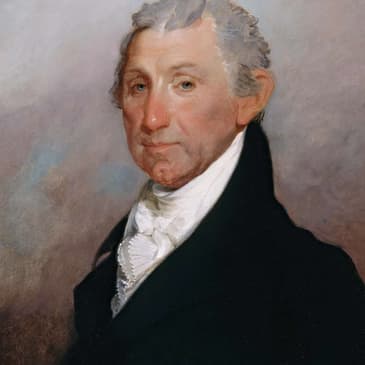
Thanks for joining us for the third part of the James Monroe story. When we left off in part two, Monroe had taken his fame from the battlefield into the world of politics to help shape his new nation at home and abroad. Now, as one of America’s most distinguished citizens, Monroe will be called upon to prevent America’s collapse, not just once but repeatedly. In so doing, he will rise to become perhaps the most famous man in America.
So, sit back and enjoy the continued story of American President and Founding Father, James Monroe.
[00:00:07] Hello everyone. Welcome to the Almost Immortal History Podcast. I'm your host, Ryan Powers. Thanks for joining us for the third part of the James Monroe story. When we left off in part two, Monroe had taken his fame from the battlefield to the world of politics to help shape his new nation at home and abroad. Now, as one of America's most distinguished citizens, Monroe will be called upon to prevent America's collapse, not just once, but repeatedly.
[00:00:34] In so doing, he will rise to become perhaps the most famous man in America. So sit back and enjoy the continued story of American president and founding father, James Monroe.
[00:01:01] As he prepared to leave the governorship of Virginia, Monroe fully grasped the magnitude and consequences of President Jefferson and Secretary of State Madison's request. The mission before him might well decide the future destiny of America. Few Americans were as well-suited to the task. Monroe was Jefferson and Madison's trusted confidant, a seasoned political veteran, and one of the few Americans who commanded respect in Paris.
[00:01:27] He understood French political culture and spoke the language fluently, enough to navigate at salons and ministries. Just as importantly, Monroe enjoyed credibility at home, particularly in the West, whose economic future depended on access to the Mississippi River. Jefferson believed that if Monroe failed, no one else could succeed. The France of 1803, to which the Monroes returned, was much changed from the one they had left in 1797.
[00:01:55] Gone were the terror, bloodshed, and confusion of its revolution. In its place stood a nation under the command of one man, Napoleon Bonaparte. It was into this transformed France that Monroe returned. During his first tour as minister, Monroe had found himself at odds with the Washington administration. Now, he returned with the full confidence of the President and Secretary of State. Even so, he still faced opposition from within.
[00:02:23] The current American minister in France, Robert Livingston, was mortified to learn of Monroe's appointment. By the time Monroe arrived in Paris in the spring of 1803, Livingston had been negotiating with the French government for nearly two years, with little to show for his efforts. Monroe's appointment, intended by Jefferson to strengthen the American position, was received by Livingston as more of an intrusion. He had labored too long and too patiently to see success credited to another.
[00:02:50] In private correspondence, he emphasized his own central role, portraying Monroe as a late arrival stepping into negotiations already shaped by his persistence. At times, Livingston moved forward independently, narrowing Monroe's opportunity to claim equal credit. The partnership, though united in purpose, was strained from the outset. Monroe, by contrast, had little appetite for personal rivalry. His earlier experience in France had left him wary of intrigue and maneuvering.
[00:03:19] While not without ambition, he viewed his purpose differently. The success of the mission, not the ownership of it, mattered most. At first, there was little reason for optimism. Jefferson's instructions had been clear but limited. Secure New Orleans, and if possible, West Florida. The expectation was that France, intent on re-establishing its colonial presence, would resist any attempt to sell.
[00:03:42] Yet, even as Monroe and Livingston navigated their uneasy partnership, events beyond their control were rapidly altering the equation. Napoleon's ambitions in the Western Hemisphere were unraveling. The prospect of renewed war with Great Britain loomed large. Should war come, France could not defend Louisiana. Worse, it might lose the territory outright to the British. Faced with these realities, Napoleon made a decision that stunned both his ministers and the American envoys.
[00:04:11] He would sell. Rather than negotiating solely for New Orleans, Monroe and Livingston were presented with the opportunity to acquire the entire Louisiana territory, an expanse that would double the size of the United States. The offer went far beyond their instructions, and for a moment, both men hesitated. The constitutional authority to make such a purchase was uncertain. The financial burden, though manageable, was significant.
[00:04:39] And yet, the opportunity was unmistakable. Monroe recognized that there was no time to seek further instructions, and knew that Jefferson had specifically provided him with broad discretion to make the final call. Monroe said as much when he wrote that, Circumstances might arise which would render it improper to postpone the conclusion. Livingston agreed. They moved quickly to finalize the agreement. The negotiations, once stalled, now advanced with surprising speed.
[00:05:07] Terms were settled, financing was arranged, and on April 30, 1803, the treaty was signed. With that single act, the United States acquired more than 800,000 square miles of territory, doubling the size of the nation. Livingston captured the significance of what they had accomplished when he wrote, From this day, the United States take their place among the powers of the first rank. Monroe agreed. The consequences were immediate and profound.
[00:05:37] Control of the Mississippi River was secured. The threat of a powerful European neighbor at the nation's western edge was removed. The path to continental expansion, long imagined but never assured, was suddenly open. News of the treaty crossed the Atlantic with anxious anticipation. And when it reached Thomas Jefferson and James Madison, it was received with a mixture of astonishment, relief, and caution.
[00:06:00] Jefferson worried whether the Constitution permitted such an acquisition, even admitting privately that an amendment might be necessary. Yet the magnitude of the opportunity quickly outweighed his hesitation. The less that is said about any constitutional difficulty, the better, he confided. In other words, better to ask for forgiveness than permission. Across the country, the reaction was swift and overwhelmingly favorable.
[00:06:27] Newspapers hailed the agreement as a triumph of Republican diplomacy, while citizens saw in it the promise of land, opportunity, and security. Even many former critics of the administration acknowledged its significance. The United States, once confined to the eastern seaboard, now possessed a continental horizon. What Monroe and Livingston had secured in Paris did more than solve an immediate crisis.
[00:06:50] It reshaped the nation's future, and within months, eager to understand the vast lands now under American claim, Jefferson would commission an expedition, led by Meriwether Lewis and William Clark, to explore what had so suddenly become the new American West. In the months that followed the treaty, the pace of diplomacy did not slow.
[00:07:13] With the Louisiana question resolved, Monroe turned again to the unfinished business of American security, most notably the question of Florida, still held by Spain. He and Elizabeth also had a very special reunion with the Marquis de Lafayette and his wife, Adrienne. They had not seen Adrienne since securing her release a decade earlier, and it had been twice that long since James Monroe and Lafayette had been together.
[00:07:36] The Marquis, only recently released after years of captivity in prison, was recovering both his health and financial footing. Monroe again came to the aid of his friend. Can nothing further be done for the unfortunate and most estimable General Lafayette, Monroe wrote to Madison? Before he could leave for Spain, events intervened. Relations with Great Britain had grown increasingly strained.
[00:08:00] British naval power dominated the Atlantic, and its policies of seizing American cargo and impressing sailors into service threatened both American commerce and national sovereignty. At the same time, Britain's war with Napoleonic France made neutrality difficult to sustain. Faced with these mounting pressures, Jefferson and Madison concluded that the more urgent diplomatic front lay not in Spain, but London.
[00:08:24] The administration needed a steady, experienced envoy who could navigate the complexities of British policy while attempting to preserve peace. Monroe, fresh from the success in France and widely respected for his judgment, was the natural choice. Monroe accepted. As minister to the Court of St. James' in London, Monroe found himself again at the center of America's most delicate negotiations.
[00:08:47] Tasked with defending American rights against the world's greatest naval power, and with doing so at a moment when the margin for error was rapidly narrowing. He was received to court by King George III, a meeting that, given Monroe's past as a Revolutionary War officer, might have been uneasy. Instead, the exchange proved unexpectedly cordial. The King, measured and attentive, treated Monroe with a respect that reflected not only his office, but the growing stature of the United States.
[00:09:16] For Monroe, it was a quiet but meaningful signal that the former colonies were no longer viewed merely as rebellious dependents, but as an independent nation in the world. Yet, beyond the formality of court, the realities of British policy proved far less accommodating. Monroe pressed American grievances, protesting the seizure of neutral ships and the continued impressment of American sailors, which was the practice of forcibly removing men from U.S. vessels and compelling them to serve in the Royal Navy.
[00:09:45] British ministers rarely conceded. To them, the war with Napoleonic France overrode all concerns. So maritime supremacy was not negotiable. Monroe came to understand that Britain did not dismiss American concerns out of hostility alone, but out of necessity. This made progress slow and often frustrating. After three years, Monroe was joined by Maryland's William Pinckney in 1806 as co-minister in a final effort to salvage relations through diplomacy.
[00:10:15] Together, they negotiated what became known as the Monroe-Pinckney Treaty, a carefully constructed agreement that improved commercial terms and acknowledged several American concerns, but failed to end the most critical one, impressment. Monroe believed it was the best Britain would offer under wartime conditions, and sent at home convinced it might preserve peace. Thomas Jefferson ultimately refused to submit the treaty to the Senate.
[00:10:38] But Monroe's deeper frustration fell on Madison, whose guidance as Secretary of State had encouraged negotiation without clearly signaling that anything short of ending impressment would be unacceptable. Monroe felt he had been left to secure peace on terms Washington would not accept. The rejection was both a personal and professional blow. Monroe felt similarly to how he felt upon his first return from France a decade earlier. Hung out to dry.
[00:11:12] As Thomas Jefferson entered the final year of his second term, it was widely assumed that James Madison would succeed him. Yet not all Republicans were fully convinced. While Madison's qualifications were unquestioned, enthusiasm for his candidacy was not universal. And as party leaders quietly weighed their options, one alternative surfaced repeatedly. James Monroe. Still smarting from what he viewed as his treatment following the failed British negotiations, Monroe made no effort to discourage those who urged him forward.
[00:11:42] As in his earlier contest with Madison two decades before, he was not opposed to Madison outright, but neither was he willing to remove himself from consideration if called upon to serve. Monroe did not campaign openly for the presidency, but his support was real and at times enthusiastic. Among those who backed him was Andrew Jackson, whose rising national stature lent weight to Monroe's quiet but credible candidacy.
[00:12:06] Watching the potential of a destructive primary develop, a worried President Thomas Jefferson wrote to Monroe saying, Touched by the President's letter, Monroe's response was equally affectionate. I have never forgotten the proofs of kindness and friendship which I have received from you. But when it came to the election, Monroe explained his point of view to Jefferson that,
[00:12:34] Should the nation be disposed to call any citizen to the presidency, it would be his duty to accept it. On that ground I rest." While recognizing that line would not be the response Jefferson would have hoped for, Monroe continued to say that, The challenge Monroe faced was not a lack of support, but a lack of resolve among those who preferred him.
[00:13:03] Many Republicans admired Monroe, or even liked him more personally, but hesitated to oppose James Madison, and by extension, Thomas Jefferson. Madison may not have possessed Monroe's ease or warmth, but he was hardly an ordinary rival. The widely acknowledged father of the Constitution, Jefferson's protege, and the sitting Secretary of State, Madison brought to the contest a formidable combination of intellect, experience, and political advantage.
[00:13:28] He was brilliant, deeply connected, and carried the full momentum of an administration preparing to pass power to his chosen successor. He also possessed an advantage that few could overlook, his wife, Dolly. Married in 1794, Dolly proved the perfect complement to her husband. Where he was serious and reserved, she was warm and magnetic. Where he was bookish and measured, she was socially gifted and instinctively political.
[00:13:56] By 1808, their partnership had become not only deeply affectionate, but politically invaluable, helping to soften Madison's edges and broaden his appeal in ways he alone could not. Together, these factors helped secure Madison the Republican nomination over Monroe, and ultimately, victory in the general election against South Carolina's Charles Pinckney. After losing 122 electoral votes to 47, Pinckney quipped, in a nod to Dolly,
[00:14:23] that he might have fared better had he faced Mr. Madison alone. As Monroe had promised, he showed no outward disappointment in defeat, and in fact, gave his active support to Madison. Though he still harbored some resentment over what he viewed as his treatment during his service as Minister to Great Britain, it did not diminish his desire to see Madison succeed. With the election behind him, Monroe, just as he had 10 years earlier, happily turned his attention to a quieter life back at home in Highland.
[00:14:52] Finally, finding the time to cultivate his farm, his efforts proved highly successful. In September 1808, they hosted the wedding of their eldest daughter Eliza to attorney and future public servant George Hay. The following year, Eliza gave birth to a daughter, Hortensia, making James and Elizabeth grandparents. Monroe also rekindled his close friendship with Thomas Jefferson. The former president welcomed Monroe often, and the two resumed their easy familiarity.
[00:15:20] During this time, Monroe also came into possession of additional land in Loudoun County, Virginia, roughly 40 miles from the nation's capital, following the death of his cousin, Joseph Jones Jr., the son of Monroe's uncle and great benefactor through life, who had himself died only a few years earlier. For all the satisfaction Highland provided, Monroe, as ever, was not made to remain apart from public life for long.
[00:15:47] In 1810, he returned to politics, winning election once again to the Virginia General Assembly, the same body that had launched his public career nearly three decades earlier. He resumed his duties with characteristic diligence, but his tenure would prove brief. During his time in the Assembly, Monroe traveled to Washington to meet privately with President Madison. The time had come to leave the past behind. The two former friends spoke candidly, put lingering resentments aside,
[00:16:16] and restored the trust that had once bound them closely together. When a vacancy soon opened on a federal court, Madison recognized an opportunity. By elevating the sitting governor of Virginia, John Tyler, to the federal bench, he cleared the path for Monroe's return to the governor's office. The reconciliation with Monroe could not have come at a better moment for President Madison. Since taking office in 1809, he had struggled to preserve the fragile peace inherited from Jefferson,
[00:16:44] but events increasingly slipped beyond his control. British naval policy continued to depress American commerce, and the practice of impressment showed no sign of abating. At the same time, a new generation of congressmen grew impatient with what they regarded as indecision. Led by Henry Clay of Kentucky and John C. Calhoun of South Carolina, these so-called war hawks pressed for a more forceful response to British aggression.
[00:17:11] As tensions escalated, Madison recognized the need for stronger leadership and greater unity in foreign policy. In 1811, he again turned to Monroe. While I am not expressly authorized to say this appointment will be offered to you, wrote Virginia Senator Richard Brent to Monroe, but I have no doubt it will. The salvation of the country is such as to make your service on the occasion indispensable. James Monroe, less than a few months into his term as governor,
[00:17:39] was now being told that President Madison was not only about to ask him to be Secretary of State, the second most powerful position in the government, but that the future of the country may well depend on his answer. The offer that Brent predicted came soon after. Monroe was flattered, and he wanted to be Secretary of State. Though despite that and his long friendship with Madison, he posed two conditions to the President before he could accept. First, out of respect for how little time he had served as governor,
[00:18:07] he wanted a letter from the President that he could share with the Virginia legislature stating the urgency of Monroe's appointment. Second, and more importantly, he wanted Madison's assurance that while he was completely loyal to the President, he wanted it known that he may have differing views and to be allowed to express those with Madison and the Cabinet. If I come into the government, my object will be to render to my country and to you all the service in my power, according to the light, such as it is, of my knowledge and experience, faithfully and without reserve.
[00:18:38] It would not become me to accept a station and to act a part in it which my judgment and conscience did not approve, and which I did not believe would promote the public welfare and happiness. I could not do this, nor would you wish me to do it. If you are disposed to accept my services under these circumstances and with this explanation, I shall be ready to render them whenever it may suit you to require them." In full agreement, Madison agreed to Monroe's request.
[00:19:09] When Secretary of State James Monroe arrived in Washington on April 6, 1811, he entered an unfinished federal city, but one that had come a long way in its first decade of existence. The population had more than doubled since 1800, but still totaled less than 10,000 people. The streets, often unpaved and muddy, cut through open fields and patches of forest. Seeing livestock roaming the city was not uncommon. The buildings were scattered rather than in orderly streets.
[00:19:37] The Capitol building, where Congress met, stood partially complete atop one of the largest hills in the city. The building was also home to the Supreme Court. John Marshall, now in his 11th year as Chief Justice, would once again live near and work alongside his friend, James Monroe. The State Department, staffed with only a handful of clerks, was located just a few hundred feet from the President's house. Monroe and Madison fell quickly back into their decades-long partnership addressing the matters at hand.
[00:20:05] Chief among them were the mounting tensions with Great Britain and France. The issue Minister Monroe had attempted to address in London, British impressment, remained at the center of the crisis. To Americans, this practice was nothing less than kidnapping and a direct assault on national sovereignty. Compounding the outrage were British trade restrictions designed to choke off commerce with Napoleonic France. Restrictions enforced through blockades that crippled American shipping and punished neutral trade.
[00:20:35] France, for its part, imposed its own decrees, further entangling the United States in the conflict between Europe's great powers. On land, British support for Native American resistance along the western frontier inflamed fears that London hoped to stem the growth of America permanently. Together, these grievances convinced Madison, Monroe, and a growing number of Americans that the nation's honor, independence, and future prosperity were being tested, and that diplomacy alone may no longer suffice.
[00:21:04] Secretary Monroe approached the growing tensions with pragmatism. He neither sought conflict, as the Congressional Warhawks did, nor turned the other cheek and assumed diplomacy alone would solve the issue. If we go to war, Monroe said to the British ambassador, we can, and shall, do each other much harm. Writing to his friend in the British government, Lord Auckland, Monroe wrote, I came into this office with the best disposition to promote an accommodation of all differences between our two countries.
[00:21:33] But under the instructions of your minister here, it has been utterly impossible to succeed. Instead of the insults and injuries which are so constantly offered to the United States, treat us as a nation having rights, possessing power, and much sensibility to national honor, and the result could not fail to be satisfactory. Chief Justice Marshall, however, was far from persuaded that war was inevitable or that America could expect victory.
[00:21:59] All who wish peace ought to unite in the means which may facilitate its attainment, he wrote to Robert Smith. In a similar letter, he wrote forebodingly that, In popular government it is, I fear, possible for a majority to exercise power tyrannically. Despite Monroe's attempts to avert war through diplomacy, war came all the same. On June 18, 1812, Congress, at President Madison's request, formally declared war on Great Britain.
[00:22:28] For the second time in less than 40 years, America and its former mother country would battle. This time, not over representation or taxation, but over national honor, sovereignty, and the right to exist as a neutral power in the world. In his message to Congress earlier that month, Madison laid the charge plainly, condemning Britain's continued practice of violating the American flag on the Great Highway of Nations
[00:22:53] and the seizure of American sailors who were torn from their country and from everything dear to them. Diplomacy, he concluded, had been exhausted. The moment of decision had arrived. Few figures were more prepared for this crisis than James Monroe. As a show of respect, he sent Chief Justice Marshall, a former Secretary of State himself under President Adams, a copy of President Madison's remarks to Congress. My thanks for this mark of your attention, replied Marshall to Monroe.
[00:23:22] My fervent wish that this momentous measure may, in its operation on the interest and honor of our country, disappoint only its enemies. Whether my prayer be heard or not, I shall remain with respectful esteem your friend. Once war was declared, Monroe's role intensified immediately. Throughout the conflict, he labored relentlessly to hold the administration together, coordinating with American ministers abroad while urging unity at home.
[00:23:50] As the war progressed, with few American victories and far too many setbacks and defeats, he became increasingly alarmed by the widening gap between the war's purpose and its execution. In private correspondence, he warned that early disasters did not reflect a lack of courage among American soldiers, but failures in the direction of the force and in the preparatory arrangements. At the center of those failures, Monroe increasingly believed, stood Secretary of War John Armstrong.
[00:24:18] Confident to the point of complacency, Armstrong dismissed warnings of British threats, concentrating forces away from likely targets, and resisting outside advice. Monroe was blunt in his assessments. He cautioned President Madison that Armstrong's assurances bore little relationship to reality, writing that essential precautions had been neglected and that the nation was paying the price for errors of judgment at the highest levels. Madison himself eventually shared Monroe's doubts, later admitting that Armstrong had
[00:24:49] As defeats mounted, Monroe came to see the War Department not merely as ineffective, but as rudderless. As a result, Monroe found himself managing the nation's foreign affairs while increasingly compelled to step into a void of leadership evident at the War Department. Back in London, the mixed news of British triumphs and their own setbacks in America prompted Prime Minister Robert Jenkinson to propose peace talks to take place in the neutral site of Ghent, Belgium.
[00:25:18] Madison and Monroe sent to Ghent five negotiators, including Speaker of the House and Warhawk Henry Clay, along with one of America's most respected diplomats and current minister to Russia, John Quincy Adams, son of former President John Adams. By 1814, Americans had tired of the war. Years of fighting had strained the nation's finances, disrupted trade through an increasingly effective British blockade,
[00:25:47] and exposed the limits of America's army. While the efforts to meet in Ghent to discuss a potential peace were underway, Great Britain, in the meantime, had finally defeated Napoleon during the Battle of Waterloo. With that defeat, the British were able to redirect their troops and naval power toward North America. Throughout the spring and summer, British ships tightened their grip along the Atlantic coast, raiding towns, seizing supplies, and spreading fear along vulnerable shorelines.
[00:26:14] Nowhere did this pressure feel more acute than in the Chesapeake region, close to the nation's capital. Sensing the looming British invasion, President Madison convened his cabinet to discuss their approach. The critical questions he posed were where the British would strike and how best to prepare. In both cases, Secretary of War Armstrong continued to prove dangerously overconfident. Convinced that the city of Washington was of little strategic value, Armstrong dismissed warnings that the capital itself was a likely target,
[00:26:44] insisting that the British would strike Baltimore instead. As a result, defensive preparations remained scattered and inadequate, leaving the nation's leadership uncertain and exposed. Weeks later, in early August, British forces landed with 4,000 troops along the Chesapeake Bay. Despite being within 40 miles of Washington, Armstrong continued to insist that Baltimore would be the target. Monroe, less certain, asked President Madison if he could ride out closer to the British
[00:27:13] to get a better sense of their intentions. After sending his wife Elizabeth and daughter Mariah from Washington to safety in Virginia, Monroe and a handful of soldiers rode south to the Chesapeake within sight of the British, stationing men every 10 miles to ensure the most rapid communications relayed to the President. After observing their movements, Monroe wrote to Madison that the British are marching in column three-quarters of a mile deep. And added with urgency that Washington is their object.
[00:27:45] Despite Monroe's bravery and foresight, Secretary Armstrong's insistence that Washington wasn't at risk meant the city was woefully unprepared for what was coming next. The enemy are in full march for Washington, wrote Monroe again to Madison. Have the materials prepared to destroy the bridges. He also added, You had better remove the records. The records Monroe referred to were the most important documents in the short history of America. Chief among them were the Declaration of Independence,
[00:28:15] the Constitution, and the Bill of Rights, known collectively as the Charters of Freedom. These famous documents, along with George Washington's military commission and correspondence, the Articles of Confederation, papers of the Continental Congress, and all existing international treaties and correspondence dating back to 1789 were stored at the State Department next to the President's house. Monroe understood that all of them could perish in the looming British attack. Upon receiving Monroe's warning,
[00:28:44] his clerks at the State Department, including Stephen Pleasanton, John Graham, and others, leapt into action, securing the documents and placing them into linen bags and onto horse-drawn carts. While evacuating, Pleasanton encountered Secretary of War Armstrong, who even at this late hour, in clear warning from Monroe, insisted that such precautions were foolish since the British would likely bypass Washington for Baltimore. We are under a different belief, a defiant Pleasanton replied to Armstrong. Believing Monroe,
[00:29:14] President Madison tried to get Dolly to evacuate as well, though she refused until she knew he would be safe. Madison rode his horse out to Maryland, where scattered American troops and militia were hastily assembling. After formally reviewing the troops, Madison returned to the President's house. Monroe rode on to Bladensburg, less than seven miles from Washington, where the British troops and the American defenses were amassing. Among them, a 35-year-old attorney named Francis Scott Key. The next morning,
[00:29:44] August 24th, President Madison, Secretaries Monroe, Armstrong, Rush, and other military commanders met in Washington to decide their next move. Armstrong, now finally conceding that the British may attack Washington, believed they would concentrate on nearby Fort Washington rather than the town itself. Monroe had heard enough and with Madison's permission rode back to Bladensburg, followed shortly thereafter by the President and other Cabinet members.
[00:30:12] 6,000 men burst into cheers upon seeing the President arrive on his horse to rally the troops. While the Americans held the advantage in numbers, the British possessed superior soldiers, officers, and tactics. The American soldiers, now hastily assembled in Bladensburg, were not prepared for what was to come. That morning, the British opened fire in Bladensburg, launching a recently developed rocket at the Americans. The goal of the weapon was less about inflicting casualties than it was to instill fear.
[00:30:41] It had its desired effect. Once the firing commenced, military commanders urged Madison and the Cabinet to fall back several hundred yards to safety. Monroe, ever the soldier, hesitated. Reluctant to retreat so quickly, he remained behind to view the enemy's progress. The Americans answered with cannon and rifle fire of their own. For a moment, they managed to slow the advance of the two British columns. But the resistance could not hold. Volunteer soldiers began to fall back,
[00:31:11] some cautiously, others in a panic. As units retreated, they tore open gaps in the American lines, openings the British quickly exploited. The collapse came so swiftly and the retreat was so widespread that the engagement earned an unfortunate nickname. Rather than be remembered as the Battle of Bladensburg, it was called the Bladensburg Races. President Madison had gradually withdrawn to higher ground to observe the fighting as it unfolded. Once it became clear the battle was lost, he turned back
[00:31:41] toward Washington. He arrived at the President's house to find it abandoned, save for their supper waiting on the table as Dolly Madison had left it. Having received word that the President was safe and that the British forces were advancing on the city, Dolly Madison fled the capital. She departed hurriedly at three o'clock, having at the last moment secured a wagon to carry as many possessions as it would hold, leaving most behind to their fate. Among the items she insisted on saving was a national treasure,
[00:32:10] Gilbert Stuart's portrait of George Washington. Our kind friend Mr. Carroll has come to hasten my departure and is in a very bad humor with me, Dolly wrote to her sister, because I insist on waiting until the large picture of General Washington is secured and it requires to be unscrewed from the wall. Unable to remove the portrait intact, she ordered its frame broken with an axe and carried away the bare canvas, taking every care to preserve it. James Monroe soon returned to Washington and conferred with Armstrong and the remaining
[00:32:39] military leaders. Monroe urged that what few troops remained take up positions on the nearby heights of Georgetown, where they might at least observe and delay the approaching assault. Armstrong and Monroe then met with Madison, Rush, and General Thomas Mason, the son of Monroe's friend and fellow Virginian George Mason, at the President's house. All agreed there was nothing more to be done. The order was given to abandon the city, Armstrong and the military retreated into Maryland. Madison, Rush, and Mason crossed the Potomac
[00:33:09] into Virginia. Monroe alone remained behind, as British troops closed in just miles from the capital city. What would come next would be nothing short of catastrophic for the city of Washington and the nation.