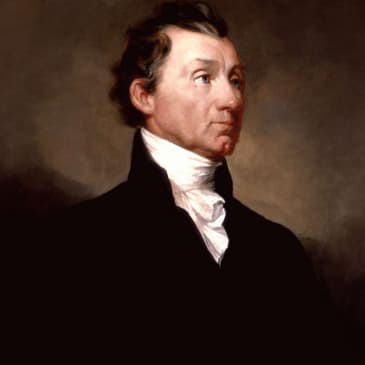
Thanks for joining us for the second part of the James Monroe story. When we left off in part one, Monroe had risen from an orphaned Virginia farm boy into a hero of the American Revolution. Now with his military career behind him, Monroe will enter the uncertain world of early American politics, help shape the young republic and forge its position on the world stage. All of this amidst the backdrop of revolution abroad, deepening divisions at home and a nation still struggling to define what it would become.
So, sit back and enjoy the continued story of American President and Founding Father, James Monroe.
[00:00:06] Hello everyone. Welcome to the Almost Immortal History Podcast. I'm your host, Ryan Powers. Thanks for joining us for the second part of the James Monroe story. When we left off in part one, Monroe had risen from an orphaned Virginia farm boy into a hero of the American Revolution. Now, with his military career behind him, Monroe will enter the uncertain world of early American politics, help shape the young republic, and forge its position on the world stage. All of this amidst
[00:00:35] the backdrop of revolution abroad, deepening divisions at home, and a nation still struggling to define what it would become. So sit back and enjoy the continued story of American President and Founding Father James Monroe. With Revolutionary War over, the United States turned inward,
[00:01:06] its attention shifting from survival to self-definition. For James Monroe, the transition was similar. Having distinguished himself in the military, he now stood at the threshold of a different kind of service. Under the guidance of Thomas Jefferson, Monroe had begun the study of law, but Jefferson envisioned more for his protege. In 1782, at the urging of both his uncle Joseph Jones and Jefferson,
[00:01:30] Monroe sought election to the House of Delegates and won. Upon assuming office, he and his fellow freshman delegate John Marshall were honored by the other members with a standing ovation. That respect extended further. Both were selected to serve on the eight-member executive council, the most prominent council in the assembly. Monroe's two years in Richmond, alongside members like Patrick Henry, did not produce landmark
[00:01:55] legislation, but the experience proved invaluable. Monroe developed a reputation not for rhetorical brilliance or ideological rigidity, but something far more enduring—steadiness. He listened carefully, forged relationships, and demonstrated a capacity to build consensus among men whose interest often diverged. It was a skill that would define his career. So strong was the impression he made that
[00:02:21] within a year, the assembly elevated him to national office, selecting him to represent Virginia in the Congress of the Confederation in Philadelphia. The Congress Monroe entered was fragile in both structure and authority. Always short of revenue and lacking the power to tax, it struggled to meet its most basic obligations. By 1783, the threat to Congress came not from foreign enemies, but from its own
[00:02:47] unpaid soldiers. Frustrated veterans owed back wages for their service gathered in armed protest, forcing Congress to flee from Philadelphia for Annapolis. One of the greatest highlights of Monroe's early tenure in Congress was reuniting with Thomas Jefferson. The former governor had left office after the burning of Richmond and retreated briefly from public life, when his wife Martha died in 1783 from complications after childbirth. Jefferson was also excited for the reunion. Ever mindful of Monroe's
[00:03:16] financial constraints, Jefferson invited him to share lodgings. Along with him came his vast library, and even a French chef named Partout. Jefferson's influence deepened Monroe's education beyond the law. Their daily conversations ranged across politics, philosophy, the natural sciences, and fine cuisine, broadening Monroe's understanding of the world around him. As Monroe had experienced in Virginia's General Assembly, the Congress struggled to address many of the young nation's needs, constrained not just
[00:03:45] by lack of money, but also the requirement of unanimous agreement among the states. Jefferson, as he had in Virginia, proposed another anti-slavery measure. The Land Ordinance Act of 1784 sought to organize western territories into future states and prohibit slavery there after 1800. Monroe supported the proposal, but in a cruel twist, illness prevented him from attending the decisive vote. The measure failed
[00:04:10] by a single vote. Monroe's first term as Congressman proved to be a momentous one. On September 3rd, 1783, Great Britain and America signed the Treaty of Paris formally ending the Revolutionary War. Three months later, Monroe witnessed one of the most extraordinary acts in human history. On December 23rd, in Annapolis, George Washington resigned his commission before Congress.
[00:04:36] Having now finished the work assigned me, Washington told the assembled body, I retire from the great theater of action. With those words, Washington relinquished power voluntarily, an act so rare that even King George III was rumored to have said that if Washington did so, he would be the greatest man in the world. For Monroe, who had idolized Washington, the moment was powerful and instructive. It defined the standard of
[00:05:05] Republican leadership for future generations. Power was to be temporarily held and then return to the people. Monroe and Jefferson as roommates came to an end in the spring of 1784 when Congress nominated Jefferson to serve as minister to France, replacing the retiring Benjamin Franklin. Monroe was happy for his friend, but saddened by the loss. I very sensibly feel your absence, not only in the solitary situation in which you've left me,
[00:05:32] but upon many other accounts, wrote Monroe to Jefferson shortly after his departure. Yet the loss opened another door. Before departing, Jefferson wrote to James Madison, saying, Colonel Monroe will be of the Committee of the States. He wishes a correspondence with you, and I suppose his situation will render him a useful one to you. The scrupulousness of his honor will make you safe in the most confidential communications. A better man cannot be.
[00:05:57] With that introduction, a new friendship had been born. James Madison, 33 years old in 1784, was already one of the leading minds of the young republic. He had served in the Continental Congress and was now back in Virginia as a delegate to the General Assembly in Richmond. With Congress adjourned and his mentor abroad, Monroe undertook an unusual journey. He set out to explore the western frontier,
[00:06:24] which stretched just beyond the 13 colonies to the Mississippi and Ohio rivers. Few national leaders had done so. Traveling by horseback, stagecoach, and boat, Monroe ventured beyond the Allegheny Mountains into territories where roughly 50,000 Americans had begun to settle. His purpose was clear. He wished, as he wrote to Jefferson, to acquire a better knowledge of the temper of the Indians towards us, as well as of the soil, waters, and in general, the natural view of the country.
[00:06:51] The journey was not without danger. Monroe acknowledged as much, joking that, I may lose my scalp, but if either a little fighting or a great deal of running will save it, I shall escape safe. What he found confirmed both opportunity and risk. Meeting with the Native American leaders, including representatives of the Six Nations, Monroe sought to distinguish American intentions from European precedent. He admitted that prior
[00:07:17] approaches had been hackneyed and assured them that it is the earnest disposition of the states to cultivate the friendship of the Indians. The trip nearly ended in tragedy. Urged by a fort commandant to delay his departure from Fort Niagara, Monroe avoided joining a trading party that was later ambushed and killed. Reflecting on his narrow escape, colleagues told him, You may certainly consider yourself as one of Heaven's favorites.
[00:07:42] The experience left a lasting impression. Monroe returned not only with the knowledge of the land, but with the conviction that the West, and access to its lifelines, would determine the nation's future. Over the next few years, Monroe emerged as one of the leading voices in Congress. Securing American navigation rights on the Mississippi River became one of his most important issues. He also believed, as his friend James Madison did, if the Republic was to endure,
[00:08:11] the Articles of Confederation would need reform. The seat of government moved again from Annapolis to Trenton, New Jersey, and finally settled in New York City. But the members of Congress, as well as its citizens, remained unsettled due to the Confederation's deep structural weaknesses. Something would need to be done. While Monroe spent most of the time acting on the issues of the nation, some of his most memorable
[00:08:35] moments came outside the business of Congress. In 1784, Monroe was reunited with his friend and former soldier-in-arms, General Lafayette, who sailed from France to join his friends in America and received a hero's welcome that lasted for months. A year later, while serving as Congressman Elbridge Gerry's best man at his wedding, James Monroe met Elizabeth Courtright and fell almost instantly in love. The daughter of a prosperous New York merchant family, Elizabeth, ten years
[00:09:05] younger than Monroe, was beautiful, intelligent, steady, but reserved. After a brief courtship, James and Elizabeth were wed on February 16, 1786, at Trinity Church in New York. In December of that same year, the couple welcomed their first child, Eliza Monroe. Mrs. Monroe hath added a daughter to our society who, though noisy, contributes greatly to its amusement,
[00:09:29] the proud new father wrote to Jefferson. While Monroe's new family brought him the greatest joy of his life, it further underscored his financial challenges. By late 1786, Monroe made the painful decision to leave Congress for financial reasons. He returned to Virginia, riding the legal circuit, practicing law from town to town. The work kept him solvent, but at a cost. He was away from Elizabeth and baby Eliza for long
[00:09:56] stretches. Unable to stay away from public service for long, Monroe was re-elected to the Virginia General Assembly in 1787, just as the nation lurched toward its next great reckoning. The failures of the Articles of Confederation were now undeniable. Trade disputes, currency chaos, and events like Shays' rebellion, a violent revolt by desperate Massachusetts farmers, had shaken confidence
[00:10:20] in Republican stability. Monroe, working closely with Madison, wrote letters urging attendance at a proposed convention to revise some of the Articles' specific issues like interstate trade and commerce. Despite their efforts, only 12 delegates from five states arrived, far too few to act. Rather than let the failure stand, two of the attendees, Alexander Hamilton and James Madison, transformed the disappointment into an opportunity, issuing a new call for a broader convention the
[00:10:49] following year in Philadelphia, intended to address all issues to meet the needs of the Union. This time, the response was decisive. Every state except Rhode Island sent a delegation, and Madison persuaded George Washington to attend, lending the gathering the authority it needed, as he was unanimously chosen as president of the convention. Monroe wanted desperately to attend, but once again, finances intervened. So Monroe remained in Virginia, watching history unfold from a distance.
[00:11:18] And while he corresponded often with Madison, who was the driving force of the convention, Monroe was unable to learn about the proceedings until they were complete, as all participants in Philadelphia were sworn to secrecy. When the Constitution finally emerged on September 17, 1787, it was the product of months of argument, compromise, and careful design. A framework meant to balance the interests of the individual states while binding them more closely together under a stronger national government.
[00:11:46] The document was then sent to all 13 states for ratification, requiring approval from at least nine to take effect. Monroe was one of the 168 delegates selected for Virginia's ratifying convention, along with Madison, Patrick Henry, George Mason, and John Marshall. Monroe's position towards the new proposed government was broadly supportive, but measured. After hearing the debates and range of opinion, he aligned himself more with the faction being called the Anti-Federalist,
[00:12:15] like Patrick Henry and George Mason, rather than with the proponents called Federalist, like James Madison, George Washington, and John Marshall, who favored approving the document as is. Monroe was not opposed to the document itself, but rather what it lacked, namely explicit protections for individual rights. The Anti-Federalists were concerned that power, once centralized, had a way of growing. And without individual rights explicitly stated in an official bill of rights,
[00:12:43] those rights that Federalists believe were implied may not endure. Monroe's performance at the Virginia ratifying convention had already marked him as one of the most thoughtful and respected Anti-Federalist voices in the Commonwealth. Though he accepted the Constitution once Virginia ratified it, he remained convinced that the new system required immediate amendment to safeguard individual liberties. A bill of rights is what the people are entitled to, and what no just government should refuse, George Mason insisted during the debates.
[00:13:12] A sentiment Monroe shared deeply. The turning point came when James Madison, recognizing that the Constitution might fail without concessions, pledged that he would work to secure a bill of rights after ratification, rather than through a second convention. This strategic promise helped Federalists win the day, but it also sharpened divisions among Virginia's Anti-Federalists, who feared that once the new government was in place, amendments might never materialize.
[00:13:39] Monroe, aligned with Patrick Henry and others who preferred a second convention to guarantee amendments, emerged from the convention as a principled critic of centralized power. In the months that followed, Henry and his allies sought to elevate Anti-Federalist figures who could press for amendments from outside the new federal structure. Monroe, popular and principled, became an ideal standard-bearer for this effort. The political currents set in motion during the ratifying conventions flowed directly into the contest for the new Congress.
[00:14:09] That tension came to a head in 1789, when James Monroe and James Madison, friends, allies and protégés of Jefferson, found themselves unexpectedly pitted against each other in a race for a seat in Congress. The contest was not of Monroe's making. Patrick Henry, still angry at Madison for advocating for the Constitution without a second convention, worked relentlessly to keep Madison out of the new federal government.
[00:14:37] Henry personally handpicked Monroe as Madison's opponent. Monroe did not seek the contest, but once drafted, he felt it his duty to offer a contrasting view. Despite the political stakes, the two friends conducted themselves with remarkable civility. They rode the district together, debated outdoors in bitter winter weather, and focused on principles rather than personal attacks. Madison ultimately won the election, to the relief of Federalist and President-elect Washington.
[00:15:05] Monroe, though disappointed, harbored no resentment. He wrote to Jefferson in Paris that while he had wished to win, he took genuine satisfaction in Madison's victory, noting that Madison had been one of the principal architects of the new system and added that, it would have given me great concern to have excluded him. Madison's victory closed one chapter, but opened another. Monroe's conduct during the campaign, principled, measured, and free of personal rancor, only strengthened his reputation across Virginia.
[00:15:35] In 1790, Virginia's Senator and James Monroe's cousin, William Grayson, died suddenly, leaving a vacancy at a critical moment in the new government. The same political forces that had drawn Monroe into the race against Madison for the House, as well as now Madison himself, rallied behind Monroe. Described by George Mason as a man of integrity, abilities, firmly attached to the country's interest, the Virginia legislature elected him to fill Grayson's seat.
[00:16:06] After his swearing in, Senator James Monroe got to work. The questions before the first Congress were profound. Treasury Secretary Alexander Hamilton proposed bold financial measures to stabilize the nation, assumption of state debts, and the creation of a national bank. These policies sparked fierce debate and further deepened competing visions for the republic. Monroe aligned with Jefferson and Madison, wary of concentrated financial power. Writing to Jefferson, he warned that
[00:16:34] the assumption of the state debts is disliked in Virginia and will create great disgust if adopted under any shape whatever. Monroe added that we still hope for the establishment of the seat of government on the Potomac. The debate over federal authority, economic power, and the role of government had begun, and Monroe was at its center. The seat of government on the Potomac River, Monroe mentioned, did come to pass. Returned from Paris, now Secretary of State Thomas Jefferson,
[00:17:03] invited Alexander Hamilton and James Madison to dine at his residence in New York. In what would become one of the most famous and consequential meals in American history, the quiet bargain struck in the room where it happened. Madison agreed to help secure the necessary votes in Congress for Hamilton's financial program in exchange for Hamilton's support in locating the nation's permanent capital further south. The site, carved from land ceded by Virginia and Maryland, would become the District of Columbia. Hamilton agreed,
[00:17:33] and within weeks, Congress passed the Residence Act, setting in motion the creation of a new federal city. Until it was ready, all agreed that the temporary capital would relocate from New York to Philadelphia. Monroe distinguished himself in the Senate, not only through policy positions, but through principle. He took a stand first on transparency of the Senate itself. "'Tis of importance that the doors be opened," he said. Our proceedings take their tone from the public mind. Excluding the people
[00:18:03] from a view of our proceedings may ripen into an odium that we are not aware of. Though his motion failed, Monroe's argument would ultimately prevail. The Senate would open its proceedings in time, affirming his belief that Republican government required public trust and visibility. As the new government took shape, political divisions became clearer. Hamilton's Federalist advocated for a strong central government. Jefferson's Democratic Republicans
[00:18:32] favored states' rights and feared central authority. Newspapers, political societies, and legislative blocs began to organize around these competing visions. Monroe emerged as a leading Republican voice, reliable in his votes, active in organization, and engaged in shaping public opinion. Monroe's rise within the Republican ranks soon placed him at the center of one of the first major political scandals of the new republic. In 1792, the House appointed Monroe
[00:19:01] as part of a three-member committee to investigate allegations that Alexander Hamilton, as Secretary of Treasury, had engaged in financial impropriety. The inquiry began as a routine examination of suspicious payments, but quickly escalated when Hamilton insisted on meeting the committee personally. In that tense discussion, Hamilton revealed that the payments in question were not evidence of corruption, but of a private affair with Mariah Reynolds, producing letters to prove the point. Monroe and his colleagues
[00:19:31] accepted Hamilton's explanation and vowed to close the matter of corruption, leaving his personal affairs to Hamilton himself. Monroe also found himself increasingly drawn into the expanding world of partisan journalism. The rise of rival newspapers, like the National Gazette on the Republican side, and the Gazette of the United States for the Federalist, shaped public opinion with unprecedented intensity. Monroe wrote under a pen name and encouraged essays defending Republican principles, while his friend John Marshall,
[00:20:00] also under a pen name, emerged as one of the Federalist's most articulate defenders. Their exchanges reflected the ideological battles of the decade. Marshall warned that Republican attacks on the administration threatened the confidence of the people in their government, while Monroe countered that unchecked executive power risked the principles of Republican liberty. Despite these political disagreements, the two men maintained their personal friendship. As America emerged from its own revolution,
[00:20:31] it was at risk of being dragged into another, an ocean away. The French Revolution, which began in 1789 with widespread American sympathy, soon descended into violence and uncertainty. What had once appeared to Americans as a sister movement for liberty grew more complicated as France executed its king, reorganized its government, and entered into war with much of Europe. In the United States, opinion divided sharply. Many, particularly those aligned with Jefferson,
[00:21:01] viewed the French struggle as a continuation of the fight against monarchy. Those closer to Hamilton saw a revolution and a nation unhinged. These divisions sharpened further when France went to war with Great Britain in 1793. The conflict threatened American trade, endangered its neutrality, and forced President Washington to act. His proclamation of neutrality, though measured, did not settle the debate. Instead, it exposed the growing fissures within the republic itself.
[00:21:30] Those tensions only deepened with the arrival of Edmond Charles Genet, the French minister who openly encouraged Americans to support France in defiance of their own government's neutrality. His actions stirred popular enthusiasm in some quarters and alarm in others. Senator Monroe watched these developments with growing concern. To him, the deterioration of relations with France was not inevitable. It was, in part, the result of misjudgment. One of the reasons for that miscalculation
[00:22:00] he believed was the current American minister to France, Gouverneur Morris. Morris was a man of undeniable brilliance, one of the principal architects of the Constitution and among the sharpest political minds of his generation. But Monroe saw in him not a diplomat suited to revolutionary France, but a liability. Blunt in manner, openly critical of the French Revolution, and lacking the tact necessary for such a volatile environment, Morris seemed to Monroe almost destined to be a good
[00:22:30] Monroe called Morris an unfit man, accusing him of a general brutality of manners and indiscretion, a temperament that gave him, as Monroe saw it, a wonderful facility on making enemies and losing friends. In Monroe's view, Morris' conduct risked pushing the United States toward unnecessary conflict. By 1794, the Washington administration reached a similar conclusion. With tensions escalating, the president sought a new approach, one that might preserve the alliance
[00:23:00] without abandoning neutrality. He turned to James Monroe. It was in many ways an unlikely choice. Monroe was an outspoken supporter of France and closely aligned with Jeffersonian Republicans. Yet it was precisely those qualities that made him valuable. Washington hoped Monroe's sympathies and credibility in Paris might stabilize the relationship and prevent the United States from being drawn into war. Monroe accepted. In his correspondence with the French government to introduce
[00:23:29] his incoming minister, Washington called Monroe one of our most distinguished citizens. Revolutionary France was still dangerous, unpredictable, and violent. Roge Pierre's reign of terror had just ended. He had been guillotined just days before Monroe arrived. Monroe understood the stakes. His mission was not simply diplomatic. It was existential. Success could preserve peace. Failure could pull the United States into a widening
[00:23:58] European conflict. Monroe crossed the Atlantic in just 29 days, a relatively short and fortunate voyage given the risk of the time. Upon arrival, Monroe met with the outgoing and displeased Morris, then prepared to present himself to the French government. His reception could not have been more different than his predecessors. Monroe delivered an impassioned speech affirming America's friendship with France and respect for its revolutionary struggle.
[00:24:27] In Paris, the response was electric. He was embraced as a symbol of republican solidarity, cheered in public, and quickly became one of the most popular foreign diplomats in the city. His wife Elizabeth proved even more captivating. The French adored her, calling her la belle américaine. She proved as effective in diplomacy as her husband, opening doors and fostering relationships that formal channels alone could not achieve. together, they became symbols of
[00:24:57] American goodwill. The Monroes used some of their newfound popularity to help free political prisoners such as Thomas Paine, whose pamphlet Common Sense had once stirred Americans to independence, and the Marquis de Lafayette's wife, Adrienne. It was James who secured Paine's release, but it was Elizabeth who deserves the credit for freeing Adrienne. Several prior attempts from other officials have been made where others failed because she transformed
[00:25:26] a political crisis into a public one. By appearing at Adrienne de Lafayette's prison door as la belle américaine, she forced French officials to consider the diplomatic consequences of executing the wife of America's great revolutionary ally. The result was a reversal that saved Adrienne's life. But Monroe's soaring popularity in France came at a cost back home. What thrilled Paris unsettled Philadelphia. Washington and his cabinet grew increasingly uneasy
[00:25:56] with Monroe's public displays of sympathy for revolutionary France, especially as tensions with Great Britain continued to mount and John Jay was sent to London to negotiate what would become the deeply controversial Jay Treaty that tilted U.S. policy towards Britain. To Monroe, the treaty felt like a betrayal of France. To Washington, Monroe's behavior felt dangerously partisan. The tension between president and minister, some earned, some misunderstood, finally broke in 1796.
[00:26:26] Monroe was recalled. His farewell in France was emotional. Crowds gathered, French officials praised him openly. You have known the true interest of our country, said one official to Monroe. You depart with our regret. We retain the remembrance of a citizen whose personal qualities have honored that title. Monroe left Paris a hero, but returned to America under a cloud. When Monroe landed in America,
[00:26:55] Jefferson was there to greet him. But notably, Monroe did not call on Washington when he passed near his home in Mount Vernon. The omission did not go unnoticed by the former president in his retirement. The rift widened. Monroe published a lengthy defense of his conduct in France, determined to preserve his reputation and tell his side of the story. In the charged political climate of the 1790s, the move only deepened divisions. At one point, Monroe even came perilously close to a duel
[00:27:24] with Alexander Hamilton after the Treasury Secretary accused him of leaking documents related to the Reynolds affair to Republican-leading newspapers. Hamilton believed the disclosure was intended to destroy his reputation. Monroe insisted to his dying day that he had not been the source of any leak. The confrontation escalated so sharply that the two men exchanged formal challenges. Ironically, the man who helped defuse the crisis was Aaron Burr. Seven years later, it would be Burr who shot and killed Hamilton
[00:27:54] in a duel of their own. With France and the Hamilton incident behind them, the Monroes returned to Virginia and settled in Albemarle County to recover financially and take a break from politics. They also eagerly awaited construction of their new home they would call Highland. Jefferson tried several times to keep his friend interested in public service. He proposed both a run for the House and the Senate. Monroe declined. Public life injures me everywhere at present, he said to Jefferson.
[00:28:23] Monroe would later describe the years between 1797 and 1799 as a period spent tranquilly at home. In March 1799, Elizabeth gave birth to their second child, a son. Monroe hoped to name him after his friend Thomas Jefferson, but Elizabeth prevailed, and the boy was christened James Monroe Jr. With the new baby and 12-year-old Eliza, the family oversaw the final construction and furnishings at Highland. The home was not as grand in manner as his neighbors' estates,
[00:28:53] but it offered something far more valuable to the Monroes, stability, peace, and surrounded by friends in the beautiful rolling hills of Virginia. Life there quickly settled into a warm rhythm, with Jefferson at Monticello and Madison at Montpelier, both nearby. Highland became a lively center of hospitality, filled with relatives, neighbors, and conversation. Time among friends and family helped Monroe heal from the political wounds of the previous years. Removed from the public spotlight,
[00:29:23] he had space to reflect on his turbulent tenure in France, the near duel with Hamilton, and the painful rupture with George Washington. By late 1799, renewed in spirit and steadied by domestic life, Monroe felt ready to return to public service. Despite Jefferson's past attempts at roles in the legislature, Monroe had a different thought, the governor's mansion. When Monroe's willingness to serve as governor became known, his allies moved quickly to shore up support and found little opposition.
[00:29:53] Tempered by experience abroad and strengthened by his steady Republican principles, he was an appealing candidate to a majority in the legislature. When the assembly met in December 1799, Monroe was elected. Before he assumed office, there was one final issue to settle. Monroe hoped to mend the breach quietly, not through public decorations, but through a private
[00:30:23] letter, measured, respectful, and free of the partisan bitterness that had colored their last exchanges. He intended to explain his conduct in France, reaffirm his lifelong admiration, and assure Washington that, whatever their disagreements, he had never acted from personal animosity. It was an attempt to restore the bond forged on the battlefields of the Revolution. But before Monroe could send the letter, Washington fell ill at Mount Vernon and died in December 1799, leaving the reconciliation
[00:30:52] Monroe sought forever unfinished. James Monroe assumed the governorship of Virginia at the dawn of the 19th century. Throughout his tenure, Monroe devoted particular attention to strengthening Virginia's militia and refining its defensive posture. In correspondence and official messages, he returned repeatedly to the necessity of organization and discipline. A well-regulated militia is the best security of a free state, he reminded lawmakers, echoing both
[00:31:22] constitutional principle and live revolutionary experience. At the same time, he pressed for reforms in public administration and fiscal management, seeking efficiency in a state still burdened by post-revolutionary debts. Monroe's governorship also reflected his enduring commitment to republican unity in a deeply divided political climate. Writing privately during his term, he warned against factional excess and the corrosive effects of party conflict, noting that the harmony of our
[00:31:51] citizens ought to be preserved with the utmost care. Monroe sought to steady Virginia through moderation, reinforcing institutions rather than inflaming divisions. The presidential election of 1800 stands apart in American history, not simply because it was the first bitterly contested election, but because it also proved whether the Constitution could survive organized political opposition. The campaign between President John Adams and Vice President Thomas Jefferson
[00:32:20] descended into open partisan warfare. Newspapers bristled with accusations of monarchy, atheism, and tyranny. When the votes were counted, Jefferson and fellow Republican Aaron Burr were tied in the Electoral College, throwing the election into the House of Representatives and plunging the young republic into its first true constitutional crisis. Yet when the dust settled, power changed hands peacefully. Jefferson would later reflect that the Revolution of 1800 was as real a revolution in
[00:32:50] the principles of our government as that of 1776 was in its form, not affected indeed by the sword, but by the rational and peaceable instrument of reform, the suffrage of the people. As the Adams administration ended, Monroe was elated for three of his closest friends, two Republicans and one Federalist. Thomas Jefferson would become president, James Madison would become Jefferson's secretary of state, and one of President Adams' last acts in office was to
[00:33:20] appoint John Marshall as chief justice of the Supreme Court. Despite his successful tenure as governor and his friend's success in national office, at the end of 1800, the Monroe's also endured tragedy. Writing to inform Madison, Monroe said that one-year-old James Jr. had died after several days of sickness and that his death had overwhelmed us with grief. Their loss was devastating and all too common among families in early America. The Monroes would go on to have one
[00:33:50] more child, a daughter named Mariah in 1802. Monroe lived his entire life within the contradictions of a slave-holding society. He owned slaves since his youth and relied on enslaved labor at Highland. Yet he also expressed his comfort with the institution and supported gradualist approaches to ending it. He supported measures that restricted the importation of enslaved people, but he did not advocate ending slavery within Virginia during his governorship. It was against this backdrop that Monroe would face
[00:34:19] one of his most difficult challenges as governor. During the same period Monroe was bearing his son, a planned uprising by enslaved black Virginians was taking shape. Gabriel, a literate blacksmith enslaved by Thomas Prosser, organized a far-reaching conspiracy inspired by the ideals of the American, French, and Haitian revolutions. The plot was uncovered before it could be carried out, and Monroe received alarming reports of an imminent attack on Richmond, including warnings that he himself might be captured.
[00:34:50] As governor, he mobilized the militia and oversaw the arrest of dozens of conspirators. Despite the panic and calls among white Virginians, Monroe did not rush to mass executions. He instead pressed the courts to proceed carefully, and even sought guidance from Thomas Jefferson about whether clemency might be appropriate. But the political climate was unforgiving. Trials were swift, and although Monroe recommended mercy in some cases, the Virginia courts condemned 26 men to death.
[00:35:19] Gabriel was hanged on October 10th. The incident would become known as Gabriel's Rebellion. In January 1803, with events accelerating beyond his control, Thomas Jefferson made one of the most consequential appointments of his presidency. Spain had quietly transferred the Louisiana Territory back to France, and then far more ominously, Spanish officials in New Orleans suspended the American right of deposit, shutting Americans out of the
[00:35:49] port and choking off Western commerce. Jefferson understood the danger. A powerful France controlling the Mississippi could fracture the Union, drive the West toward rebellion, or force the United States into a war it was utterly unprepared to fight. Diplomacy, not force, was the only viable path. And for that task, Jefferson turned Governor James Monroe. Jefferson did not disguise the challenge. In a private letter, he told Monroe that
[00:36:18] the mission was unavoidable and refusal impossible, because, all eyes, all hopes, are now fixed on you, for on the event of this mission depends the future destinies of this republic. The goal was audacious but simple. By New Orleans. Jefferson authorized Monroe to join the American minister in Paris, Robert Livingston, and gave him unusually broad discretion, an admission that events were moving too fast and
[00:36:48] communications too slow for rigid instructions. Monroe stepped down as governor and accepted the post to France. Monroe's mission could not have been more consequential, nor its outcome more uncertain. War fever simmered in America's western territories as Napoleon's intentions remained unclear. If France refused to sell New Orleans, Jefferson privately contemplated the unthinkable, an American alignment with Britain to prevent a French empire in North America.
[00:37:17] The mission, therefore, extended far beyond the acquisition of one town. Monroe's success or failure may determine nothing less than whether the United States remained a continental republic or became only a shared, fractured coastal nation.